
Search results

Paris Faces Systemic Child-Abuse Scandal as 235 Investigations Reach City Hall
Paris prosecutors are now handling around 235 investigations into suspected physical and sexual abuse of children in kindergartens, primary schools and after-school care programmes. The cases involve 184 institutions across the French capital. The scale has become so large that Paris prosecutor Laure Beccuau described it as a “real judicial tsunami.” At the end of August, authorities were reporting around 203 active investigations. Within days, that number had risen by roughly 30. The focus is no longer limited to individual teachers, carers or other employees. Investigators are also examining how recruitment, supervision, complaints and child-protection procedures operated across the municipal system.A separate part of the inquiry concerns the potential responsibility of Paris City Hall. Current mayor Emmanuel Grégoire and his predecessor Anne Hidalgo have come under scrutiny following complaints from families and questions over how much senior officials knew about problems in the after-school care system and how they reacted to earlier warnings. Prosecutors must now determine whether the issue involves only political and administrative responsibility or whether there could also be grounds for criminal liability. The fact that officials are being examined does not mean guilt has been established, but the investigations have clearly moved beyond isolated incidents and into the structure of the city’s child-care system itself.
Pro-Russian Terrorist Group Threatens Latvian Companies Supplying Weapons to Ukraine
The pro-Russian terrorist group Global Citizens Against War 1984, or GCAW1984, has sent threats to defence companies in Latvia, Poland and Portugal, demanding that they stop producing and supplying weapons to Ukraine. In Latvia, the companies named are Eraser and Unitruck. The group set a deadline of 7 October and said that if its demands are ignored, it intends to stop the companies’ operations “by any means necessary.” Latvian Interior Minister Jānis Dombrava said the threats are being taken seriously and that security has already been strengthened at sites considered potentially vulnerable to sabotage.Latvia’s Constitution Protection Bureau considers the campaign an attempt to intimidate defence companies and weaken support for Ukraine. By threatening weapons manufacturers directly, the group is trying to put pressure not on political statements or government declarations, but on the companies that actually produce and supply military equipment, ammunition and other systems. Similar demands were sent to companies in Poland and Portugal, turning the threats into a coordinated pressure campaign targeting several European countries at the same time.In Poland, GCAW1984 named PGZ, WB Electronics, JFG Composites and Nitro-Chem among its targets. In Portugal, the threats were directed at drone manufacturer Tekever. All of the companies received essentially the same demand: stop activities connected with supplying weapons to Ukraine.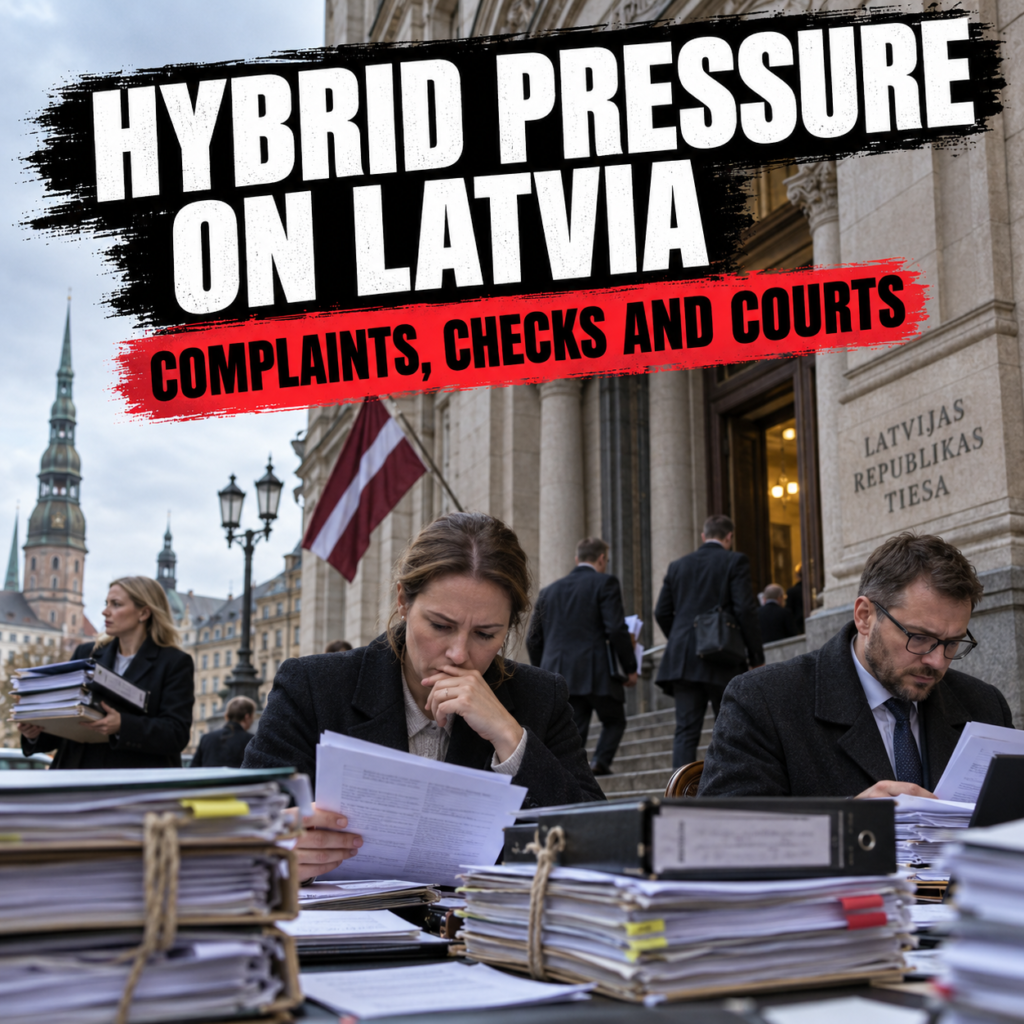
Latvia Faces New Hybrid Pressure Through Complaints, Inspections and Court Cases
Latvian security services are warning about a possible new instrument of hybrid pressure in which state institutions are overwhelmed with numerous information requests, complaints and court proceedings submitted by people based in Belarus or Russia. This is not a cyberattack and does not involve direct interference with government systems. Instead, it relies on entirely legal administrative procedures. State institutions are required to respond to requests, examine complaints, conduct inspections and defend their decisions in court. When such applications are submitted systematically and in large numbers, they can consume significant administrative resources while potentially being used to collect information about the internal operations of Latvian state institutions.At the centre of the case is Dmitrijs Matajevs, who moved from Latvia to Belarus after criminal proceedings were launched against him, and the Latvia-registered association “Bukultu iedzīvotāji” linked to him. In 2026 alone, the Administrative Court received ten applications from the association concerning access to information, with proceedings opened in eight cases. Requests and complaints involved the police, the Ministry of the Interior, Riga Municipality, the Ministry of Agriculture, Salaspils Municipality, the State Labour Inspectorate, the Museum of the History of Medicine and the Ministry of Health.
Lorena Isceri’s Death Reignites Italy’s Debate Over Femicide and Prevention
Italy has been shaken by the death of 45-year-old Lorena Isceri, who investigators believe was killed by her former partner after being abducted in Florence. The killing took place on 3 September 2026 and immediately attracted national attention because it is being treated as the seventh suspected femicide in Italy within just a few weeks. According to investigators, Isceri was forced into a vehicle, driven away and later taken to a motorway bridge, where she was allegedly thrown to her death. The case has triggered renewed debate not only because of the brutality of the killing, but also because Italy only recently strengthened its legislation by recognising femicide as a separate criminal offence carrying the country’s harshest penalties. Yet the continuing series of killings suggests that tougher laws alone have not produced the expected change.That contradiction is now at the centre of the national discussion. On one side, authorities have repeatedly stressed that the state is strengthening its response to violence against women, expanding criminal sanctions and imposing tougher punishment. On the other, women continue to be killed, often by current or former partners and frequently in situations involving threats, stalking, controlling behaviour or an inability to accept the end of a relationship. Isceri’s death has become another example of how danger can intensify precisely when a woman tries to leave a destructive relationship.
Tens of Thousands in Croatia Demand Removal of Hazardous Waste from Lika
Tens of thousands of people gathered in Zagreb’s central square on 5 September demanding the immediate start of a full cleanup around Gospić, where authorities previously discovered enormous quantities of illegally dumped waste. The demonstration became one of the largest seen in Croatia in recent years and showed that what began as a local environmental problem has developed into a major national scandal. The dispute centres on between 34,000 and 37,000 tonnes of waste found in the Lika region, much of it imported from Italy in 2023 and 2024. The materials discovered at the site include industrial, plastic, construction and medical waste, while environmental groups have warned about possible risks to soil, air and drinking water.Demonstrators demanded not only faster cleanup operations but also full political and criminal accountability for those responsible for allowing one of Croatia’s most environmentally valuable regions to become a massive dumping ground. Public anger has intensified because authorities had already promised action, while residents and environmental groups say visible progress remains too slow and limited. The government says remediation is moving forward in stages, procurement procedures have been launched and the first removal operations are being prepared. Protesters, however, argue that after waste on such a scale was uncovered, the state should have responded much faster, more decisively and with far greater transparency.
Berlin Refuses to Pay Hackers After Major Breach of Government Network
Berlin authorities have refused to pay a ransom demanded by the Rhysida hacking group after a major cyberattack on the German capital’s government network. The group claims it stole around 5.7 terabytes of data and offered the material for sale on the dark web, demanding a minimum payment of 30 bitcoin, worth roughly €2 million. Berlin’s Senate has confirmed the extortion attempt and the possibility that a large volume of information was taken, while stressing that both the exact amount of stolen data and its contents are still being investigated. The city has made clear that it will not meet the attackers’ demands.The main danger now is no longer simply disruption to the network itself, but the possible publication of the stolen information. Berlin authorities say the affected files may contain personal data relating to public employees, residents and companies. The hackers threatened to release or sell the information after a deadline set for September 4, 2026. Officials also say there is currently no evidence that the attackers still have active access to the government network. The crisis has therefore moved from the stage of technical intrusion into the much more complicated problem of a potentially large-scale data leak and the long-term misuse of stolen information.The cyberattack was detected in August. During the subsequent investigation, authorities concluded that data may have left the network before external connections were cut on August 14.
32 People Remain in Custody in Netherlands After Armed Attack Linked to Drug Crime
Dutch authorities are continuing to investigate one of the most unusual armed attacks seen in the country in recent months, with 32 people still in custody after a shooting at a private house in Overasselt. The incident took place in the early hours of September 1, 2026, when a large group of people, some of them armed, arrived at a property on Ewijkseweg. A 51-year-old security guard was killed and two police officers were wounded by gunfire. Police launched a large-scale operation and arrested 34 people, while prosecutors later decided to keep 32 of them in custody. The suspects include citizens of France, the Netherlands, Algeria, Libya, Ukraine and Belgium, including two French minors aged 16 and 17.The main question for investigators is no longer only who fired the shots, but why dozens of people arrived at the same house at the same time and who organised the operation. Authorities are examining a possible international drug-related conflict involving a large quantity of cocaine, although that theory has not been proven. A threatening video later appeared online in which masked men claimed that a person linked to the house had allegedly stolen more than a tonne of cocaine and two trucks. Police confirmed that they are examining the video, but both its authenticity and the claims made in it still need to be verified. The cocaine theory therefore remains part of the investigation rather than an established fact.
L’avvocata generale della Corte UE definisce discriminatorie le regole italiane per la polizia
L’avvocata generale della Corte di giustizia dell’Unione europea Tamara Ćapeta ha concluso che la combinazione tra il divieto italiano di tatuaggi visibili per gli agenti di polizia e l’obbligo di indossare uniformi cerimoniali diverse per uomini e donne può costituire una discriminazione diretta fondata sul sesso. Le conclusioni sono state presentate il 3 settembre 2026 nella causa C-320/25 Lertimene, nata dopo l’esclusione di una donna da un concorso per entrare nella Polizia di Stato italiana a causa di un piccolo tatuaggio floreale sul polpaccio sinistro. Per la candidata il tatuaggio risultava visibile con la divisa femminile, che prevede gonna e scarpe, mentre lo stesso tatuaggio su un candidato uomo sarebbe stato coperto dai pantaloni.Dal punto di vista giuridico, non si tratta ancora di una sentenza della Corte di giustizia dell’UE. Le conclusioni dell’avvocata generale non sono vincolanti per i giudici, che delibereranno separatamente e pronunceranno la sentenza in un momento successivo. La posizione di Ćapeta è però rilevante per le regole italiane di reclutamento, perché mette direttamente in discussione la possibilità di escludere automaticamente una donna da un concorso a causa di un tatuaggio la cui visibilità dipende dal tipo di uniforme previsto per il suo sesso. Il punto centrale del caso non è quindi la liceità dei tatuaggi in quanto tali, ma l’effetto diverso che la stessa regola può produrre su candidati uomini e donne.
Brussels prosecutor warns of sharp rise in armed violence between drug gangs
Brussels prosecutors are warning that armed violence linked to the city’s drug trade has escalated sharply in 2026. Since the beginning of the year, authorities have recorded 69 incidents involving firearms across the Belgian capital, while the total since the start of 2025 has reached roughly 170. Chief Brussels prosecutor Julien Moinil says most of the recent violence is linked to rival drug groups fighting over territory and control of profitable street-level markets. What alarms prosecutors most is not only the number of shootings but the way they are being carried out. Automatic and military-style weapons are increasingly appearing in densely populated districts, and one of the recent targets was even a police station in Anderlecht.The growing danger is no longer confined to people directly involved in organised crime. Recent incidents have taken place near restaurants, homes and busy streets, increasing the risk to ordinary residents and passers-by. In one case, customers inside a pizzeria had to take cover during automatic gunfire. In another, a bullet struck the window of a residential property while a woman was still inside. Moinil has warned in unusually direct terms that anyone can now become an accidental victim. The message from prosecutors is that Brussels is no longer dealing only with criminals shooting at other criminals, but with a wider public-safety problem created by an increasingly violent struggle over the city’s drug economy.