
Search results

Women Removed from Eiffel Tower Posts for Religious Delegation, Staff Went on Strike
A dispute at the Eiffel Tower has escalated into a wider controversy over gender equality, workers’ rights and the limits of religious accommodation in public spaces. According to employees and the CGT union, during a visit by a Hindu BAPS delegation on 5 September, female members of staff were asked to leave some of their workstations, avoid certain areas and, in some positions, were replaced by male colleagues. Employees objected strongly, arguing that the religious preferences of visitors should not determine whether women are allowed to remain at their posts. The dispute culminated in a strike on 7 September, temporarily closing the Eiffel Tower to visitors.Paris authorities have since opened an inquiry into what happened and who authorised the arrangements. BAPS denies asking for women to be removed or excluded from parts of the tower and says the delegation’s visit had been organised in advance with management. The organisation also apologised for the situation. The investigation now centres on a simple question: whether female employees were treated differently solely because of their sex in order to accommodate the religious practices or presumed preferences of a visiting group.According to staff representatives, employees are accustomed to special arrangements for official guests, large delegations and security-sensitive visits. The objection in this case was not the existence of special procedures, but the fact that women were allegedly singled out.
Spain Loses Nearly 163,000 Jobs in August After Summer Tourism Peak
Spain’s labour market cooled sharply in August 2026 after a strong summer tourism season, with the average number of workers registered with Social Security falling by 162,840 compared with July. Registered unemployment also increased by another 44,419 people. At first glance, the figures look severe, particularly after several months of employment growth, but they do not point to a sudden collapse in the Spanish economy. August is traditionally a weak month for employment because many temporary summer contracts in tourism, hospitality, restaurants and other seasonal industries come to an end before autumn. The monthly decline therefore reflects a strong return from peak-season employment toward more normal levels rather than evidence that the wider labour market has suddenly broken down.The broader numbers remain considerably stronger than the headline loss of nearly 163,000 jobs suggests. Spain still has more than 22 million people registered as employed, while total registered unemployment remains at its lowest August level since 2007. Compared with August 2025, the labour market is also in a better position, with substantially more workers registered with Social Security and fewer unemployed people. Once normal seasonal fluctuations are removed, the picture is even more resilient. The central conclusion is therefore clear: August brought a significant seasonal correction after the tourism peak, but there are still no convincing signs of a systemic labour-market crisis.
Minimum Wages Rise Across Almost All of Europe and Finally Outpace Inflation
Minimum wages increased in 21 of the 22 European Union countries that operate a statutory national minimum between January 2025 and January 2026, according to a new Eurofound report published on 1 September 2026. That means roughly 95% of EU countries with a national minimum wage raised it during the period. Slovenia recorded the strongest increase at 16%, while Bulgaria, Slovakia, Lithuania and Hungary followed with rises of roughly 11–12%. The most important change, however, is not simply the size of the nominal increases. In most countries, minimum wages rose faster than inflation, meaning low-paid workers gained real purchasing power rather than merely receiving larger payslips that were immediately absorbed by higher prices.For millions of workers, that marks an important break with the previous inflationary period. In recent years, a 7–10% pay increase could still leave households worse off if food, energy, housing and transport costs rose at a similar or faster pace. In 2026, the picture is different. Inflation has slowed while governments continued lifting statutory wage floors relatively aggressively. As a result, minimum-wage workers in much of Europe are finally seeing real income growth. The shift is especially visible in Central and Eastern Europe, where minimum wages historically lagged far behind western European levels and where governments are trying to close part of that gap more quickly.Slovenia recorded the largest increase of the current cycle, with a 16% rise.
Volkswagen Prepares Detailed Timeline to Close Four German Plants by 2034
Volkswagen has moved beyond general warnings about potential factory closures in Germany and is now considering a concrete internal timetable for ending production at four major sites. According to a management proposal prepared for the company’s supervisory board, production would stop in Emden and Zwickau in 2031, Hanover in 2032 and Neckarsulm in 2034. The supervisory board is due to discuss the document on 4 September 2026. The proposal has not yet been formally approved, but the existence of specific dates marks a significant escalation in Volkswagen’s restructuring debate and shows that the company is considering a far deeper reduction of its German industrial footprint than previously acknowledged.The plan is particularly important because it does not merely describe temporary production cuts or lower factory utilisation. It reportedly includes the transfer of future model programmes from Germany to lower-cost European locations. The successor to the ID.4 would move from Emden to Mladá Boleslav in the Czech Republic, the successor to the Audi Q4 e-tron from Zwickau to Bratislava, a future electric commercial-vehicle programme from Hanover to Poznań, and the successor to the Audi A8 from Neckarsulm to Leipzig. If implemented, the strategy would amount to a long-term reorganisation of Volkswagen Group’s manufacturing geography rather than a short-term response to weak demand.
EU Recognises Hybrid Work as a Permanent Part of Europe’s Labour Market
Europe’s debate over remote work has effectively entered a new phase. In a major report published on 27 August 2026, Eurofound no longer focuses primarily on the old question of whether employees should eventually return fully to the office after the pandemic. Instead, the European agency treats hybrid work as an established and lasting feature of the modern labour market and examines a different problem: how employers should manage teams in which some employees are in the office, others work from home, and schedules constantly change. According to the European Working Conditions Survey, around 24% of workers in the European Union can already be classified as hybrid employees. That is a large enough share for hybrid work to be considered a structural feature of employment rather than a temporary experiment introduced by technology companies.The new report shifts attention away from where people work and toward the quality of management. Employers increasingly have to assess performance without seeing staff constantly, guarantee equal access to information and career opportunities, maintain communication between people working in different locations and monitor employee wellbeing at the same time. Eurofound argues that traditional office-management practices do not transfer easily into a hybrid environment without significant adjustment. Simply requiring employees to be present in the office several days a week does not solve coordination problems.
Norway’s unemployment begins to fall as young people return to labour market
Norway’s labour market has produced a more positive signal after several months in which rising unemployment had become one of the economy’s more visible weaknesses. In July 2026, around 138,000 people were unemployed, leaving the unemployment rate at 4.5% of the labour force. Earlier estimates were also revised, with the June figure adjusted down to the same 4.5% level. After a period in which unemployment had remained close to higher levels, the latest numbers suggest that the deterioration may finally be stabilising. The composition of the change is particularly important because the improvement is not limited to the total number of unemployed people but is also visible among younger workers, whose position had become increasingly worrying over the previous two years.Since the beginning of 2026, unemployment among Norwegians aged 15 to 24 has fallen by approximately 0.6 percentage points. At the same time, the participation rate among young people has increased by around 0.9 percentage points, while employment in the same age group has risen by roughly 1.1 points. That combination is significant because youth unemployment is not falling simply because young people are giving up their job searches and disappearing from the labour force. More young people are participating in the labour market while a larger share are also finding employment.
Sweden’s labour market turns upward as employers seek to fill 159,500 jobs
Sweden’s labour market showed one of its clearest signs of recovery in the second quarter of 2026 after a prolonged period of weakening demand for workers. According to Statistics Sweden, employers reported 159,500 open positions across the economy, around 8% more than in the second quarter of 2025. The statistical agency notes that the annual difference remains within the margin of statistical uncertainty, but the overall direction has changed enough for SCB to describe labour demand as increasing after an extended period of decline. Particularly striking is the fact that employers wanted someone to start almost immediately for 106,100 of those positions, showing that a large share of the demand reflects real and current staffing needs rather than vacancies opened for future expansion.The latest figures become even more significant when compared with previous quarters. In the first quarter of 2026, Statistics Sweden counted 143,600 open positions and said the market still lacked a clear direction because demand remained broadly stable. In the fourth quarter of 2025, the number had fallen to only 114,700 and was still declining. The rise to 159,500 in the second quarter therefore looks less like a simple seasonal fluctuation and more like the first clear sign that companies are becoming more active in recruitment again.
Diageo sharply reduces direct employment in Italy after agreement covering 86 redundancies
The dispute over the future of Diageo’s Italian operations reached an important turning point after lengthy negotiations between the company and trade unions in Milan. Late on 27 August 2026, the two sides signed an agreement covering 86 employees who had previously been declared redundant as part of the group’s global restructuring programme. Under the agreement, these workers cannot be dismissed before 31 October, while those who ultimately leave the company will receive financial compensation linked to length of service, together with professionally funded support for finding new employment. Formally, the agreement gives employees additional time and a degree of financial protection, but it does not reverse Diageo’s underlying plan to drastically reduce its own workforce in Italy.Italian trade unions are therefore presenting the outcome in stark terms. Uila Lombardia argues that Diageo’s global restructuring is effectively leading to the elimination of direct employment by the group in Italy, despite the social protections secured through negotiations. Of the 127 employees in the Milan structure, 86 are covered by the current redundancy procedure, while another ten managers are expected to be handled separately. That means the total number of potential departures could reach 96. At the same time, Diageo plans to shift more responsibility for its products to commercial partners, fundamentally changing the way the group operates in the Italian market.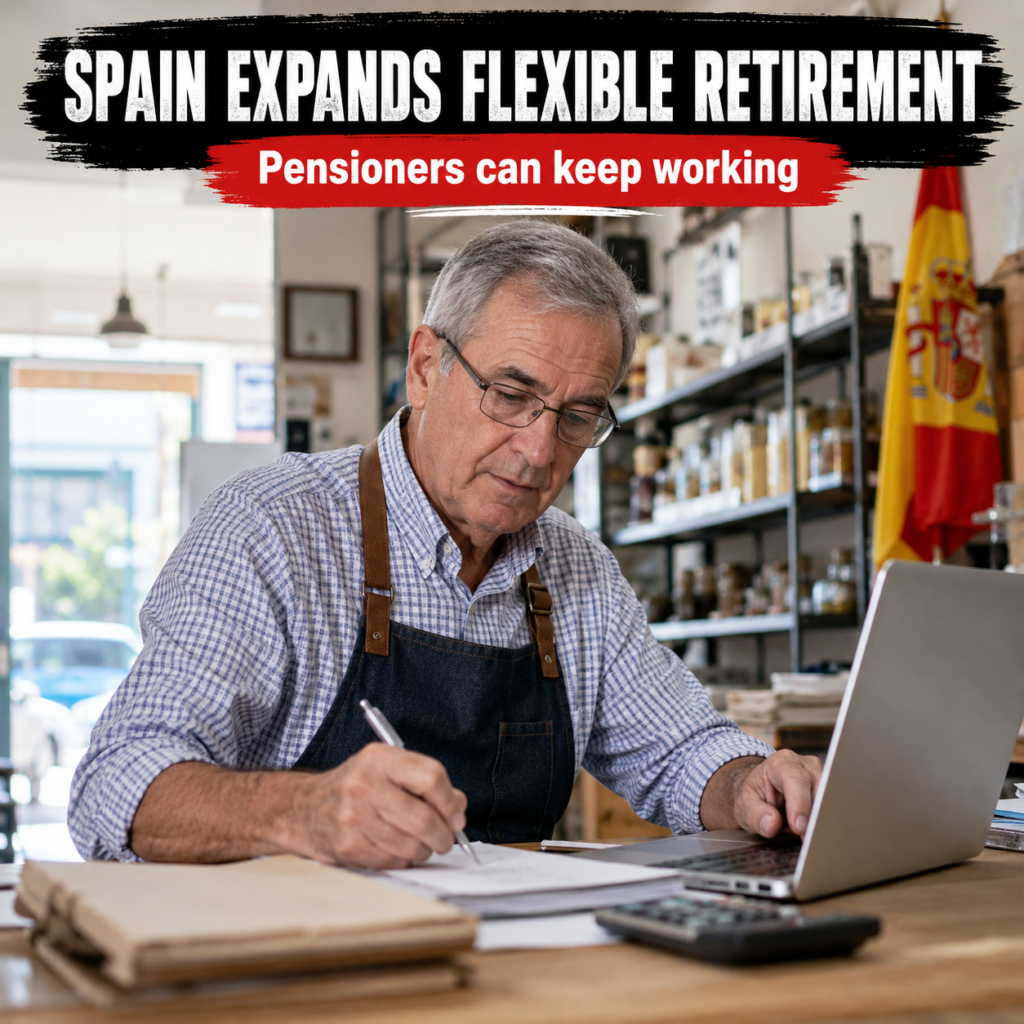
Spain expands flexible retirement, allowing pensioners to work more while keeping benefits
From 28 August 2026, Spain is operating a significantly expanded flexible-retirement system that gives people who have already claimed a pension much more freedom to return to work without losing their pension status. Real Decreto 416/2026 changes the previous model in several important ways: it increases the permitted amount of paid employment, opens flexible retirement to certain forms of self-employment for the first time, and introduces additional financial incentives for people who return to work after a period of retirement. Formally, this is a pension reform, but in practice Spain is creating a much broader transition zone between full-time employment and complete withdrawal from the labour market.For Spain’s labour market, the reform is particularly relevant because of population ageing and persistent shortages of experienced workers in some professions. A pensioner working as an employee can now work between 33% and 80% of normal full-time hours while continuing to receive a corresponding share of their pension. Under certain conditions, the compatible pension can be increased by an additional 15% or 25%, while some pensioners will also be allowed to work as self-employed autónomos and retain 25% of their pension. The basic idea is to make retirement a gradual process rather than a single moment when professional activity ends completely.The new system is regulated by Real Decreto 416/2026 of 27 May, which entered into force three months after its publication.