Search results

Swedish Schools Save on Local Food as Farmers Demand Fairer Rules
Swedish farmer Lisa Valleräng from Hedesunda has raised a question for the country’s leading politicians that quickly goes far beyond an ordinary debate about school meals. The state requires local farmers to follow strict rules on animal welfare, environmental protection and food production, while municipalities and other public institutions can still choose cheaper imported products. Valleräng points to a simple example: Thai chicken that costs less than Swedish chicken. According to her, some imported food is produced under conditions that would not meet Swedish requirements and, in certain cases, could even be illegal for a domestic producer. That creates an obvious contradiction: why force Swedish farmers to operate under expensive and demanding standards if public procurement later rewards suppliers who are not required to meet those same standards?The dispute touches several sensitive issues at once: food security, the future of domestic agriculture, the quality of school meals and the state’s treatment of local producers. Valleräng is not arguing that Sweden should weaken its rules for farmers. Her point is the opposite: if the country considers high standards of animal welfare and environmental protection important, those same principles should also influence what schools, hospitals and other public institutions buy.
Legendary Paris L’Alcazar Reopens After Major Renovation as Restaurant, Show and Nightlife Venue
Paris institution L’Alcazar reopened on September 1, 2026, after a major transformation, returning one of Saint-Germain-des-Prés’ best-known addresses to the French capital’s nightlife map. For Paris, this is more than the reopening of another fashionable restaurant. The venue has a long cultural history connected with the Left Bank, music, performance and generations of international stars. Operating since 1968, L’Alcazar has welcomed names including David Bowie, Liza Minnelli and Joséphine Baker. Its new incarnation combines dining, live entertainment and a late-night programme, attempting to preserve that history while adapting the venue to the way people now spend an evening in Paris.The most important part of the comeback is not simply the redesign or the menu, but the decision to make performance part of dinner itself. Singers, dancers and acrobats appear during evening service, turning the restaurant into a hybrid of dining room, cabaret and nightlife venue. At a time when European nightlife is increasingly divided between conventional fine dining and separate club experiences, L’Alcazar is betting on something more theatrical: an evening where food, performance and atmosphere are treated as a single experience rather than three different destinations.For Paris, the project also has a wider cultural dimension.
Rome Prepares Massive Vinòforum With 800 Wineries, 3,200 Wines and Star Chefs
From 7 to 13 September 2026, Rome will transform Piazza di Siena in Villa Borghese into one of the largest gastronomic venues of the early Italian autumn. The 23rd edition of Vinòforum will bring together more than 800 wineries presenting around 3,200 labels from across Italy as well as selected international producers. Over seven evenings, the wine programme will be joined by chef-led dinners, restaurants, masterclasses, tastings, meetings with producers and special projects featuring prominent chefs and pizza makers. The scale of the event has long moved it beyond the category of a simple city festival: Rome’s official tourism service describes Vinòforum as the second-largest wine exhibition in Italy and the largest in the central and southern part of the country.In 2026, the festival is placing noticeably greater emphasis on education. Alongside professional wine tastings, the programme will include olive oil, regional products and a dedicated project by the Consorzio del Parmigiano Reggiano. Vinòforum will also present the first official Parmigiano Reggiano taster course in Rome, with training scheduled to begin in October. Piazza di Siena will therefore become not only a vast tasting area for one week but also a meeting point for producers, restaurateurs, professional buyers and ordinary visitors within a single event devoted to contemporary Italian gastronomy.Vinòforum will open each evening at 19:00.
Brussels’ Famous Restaurant Tram Returns to the Streets for a New Season
Brussels’ Tram Experience has returned after its seasonal break, bringing back one of the Belgian capital’s most distinctive gastronomic projects. The concept combines a journey through the city with a full restaurant menu served aboard a specially adapted historic tram. The new season began on 28 August 2026 and carries an additional symbolic dimension: part of the programme is dedicated to the 100th anniversary of Comme Chez Soi, one of Belgium’s most celebrated restaurants. For Brussels, this is more than the return of a popular tourist attraction. It is also a way of showing how gastronomy, public transport and urban identity can work together as part of a single city experience.The story is interesting beyond the restaurant world. Tram Experience has long served as a showcase for Belgian cuisine, giving chefs an opportunity to present their work not in a conventional dining room but in a moving space travelling through the city itself. For the 2026–2027 season, the project again relies on well-known chefs, changing menus and the atmosphere of a format that remains unusual even by European standards. At the same time, it reflects Brussels’ wider effort to present itself not only as Europe’s administrative capital but also as a destination built around food, culture and memorable urban experiences.Tram Experience has operated for years as a city and tourism project centred on a specially converted tram that travels through Brussels while providing full restaurant service on board.
Indonesia’s Free Meal Program Faces Deepening Scrutiny After Hundreds Fall Ill
Indonesia’s government is facing renewed pressure over its nationwide free meal program after nearly 800 people reportedly fell ill in a series of food poisoning incidents linked to publicly funded meals. What was launched as one of the flagship social initiatives of President Prabowo Subianto has increasingly become associated not only with promises to improve child nutrition, but also with repeated questions about food safety, weak oversight, funding pressure and the ability of the state to control a program operating on a vast scale across a geographically complex country.The latest incidents have made the issue impossible to treat as a minor operational problem. When hundreds of students become sick after eating meals distributed through a government program, the political damage quickly extends far beyond local kitchens or individual suppliers. It raises broader doubts about how the program is managed, whether quality standards are being enforced consistently, and whether the ambition of the project has moved faster than the systems needed to keep it safe. That is why the current story is no longer just about several cases of food poisoning. It is about the credibility of one of the Indonesian government’s most visible social policies.The most recent wave of illness involved several separate outbreaks in different parts of Indonesia. The largest reported episode took place in Sidoarjo, East Java, where more than 500 students were affected.
Italian Restaurants in Riga Offer a Diverse Taste of Italy Across the City
Italian cuisine has become a firmly established part of Riga’s restaurant scene, and the choice now extends far beyond the familiar combination of pizza and pasta. Across the Latvian capital, diners can find restaurants focusing on Neapolitan-style pizza, broader regional menus, contemporary interpretations of Italian classics and smaller venues built around a more intimate atmosphere. This variety has made Italian food one of the most accessible and consistently popular international cuisines in Riga. For residents and visitors who enjoy the flavours of Italy but cannot travel there regularly, the city now provides enough different options to make an Italian-style dinner easy to arrange without leaving Latvia.Several restaurants illustrate how varied this segment has become. Bella Napoli, Italissimo, RIONE pizza&cocktails, Casa Nostra, La Casetta Riga and DILETTANTE all approach Italian cuisine differently, with some emphasising pizza, others offering wider menus, and several combining food with a more contemporary bar or evening format. These places are not interchangeable, and that is precisely what makes the Italian restaurant scene in Riga more interesting. Instead of one standard interpretation, diners can choose according to mood, company and occasion, whether they are looking for a casual meal, a longer dinner, a quieter table or a more social evening in the city centre.Italian cuisine works particularly well in Riga because its basic structure is immediately understandable.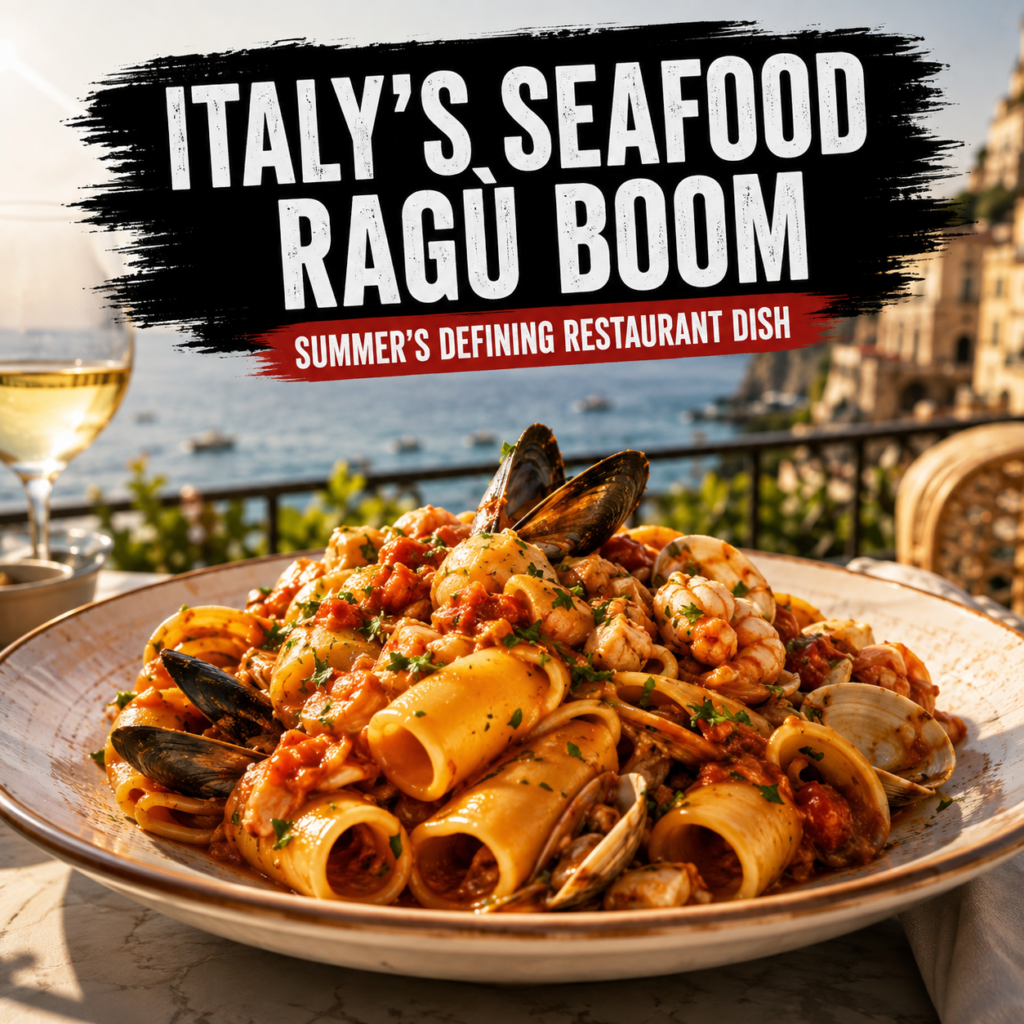
Seafood ragù became the defining restaurant dish of Italy’s summer 2026
Italy’s restaurant scene shifted noticeably during summer 2026, moving away from the familiar dominance of spaghetti alle vongole, conventional seafood pasta and the recent obsession with red prawns served with stracciatella. The dish that emerged most clearly across menus was ragù di mare — seafood ragù. It appeared in restaurants throughout the country in many different forms, paired with paccheri, spaghettoni, fresh cavatelli, Sardinian fregola and delicate tagliolini. This was no longer an isolated idea associated with a few ambitious chefs. It became a recognisable seasonal trend, increasingly treated as one of the strongest pasta directions of the summer. Earlier favourites have not disappeared, but red prawns, stracciatella and fish tartare now increasingly share space with deeper and more concentrated seafood sauces.The growing popularity of ragù di mare also shows how quickly contemporary Italian cooking can change while remaining firmly rooted in traditional technique. Unlike meat ragù, which often follows recognisable regional structures and established recipes, seafood ragù is much more flexible. It can be white or tomato-based, made from one type of fish or several, and can include shellfish, squid, cuttlefish, prawns, monkfish, sea bream, meagre or smaller local species. What unites the different versions is not a strict list of ingredients but the way flavour is built.