
Search results

Riga TV Tower Begins €38.63 Million Transformation into a Modern Infrastructure Hub
After a tender process that lasted more than two years, LVRTC has signed a contract for the reconstruction of the Riga Radio and Television Tower on Zaķusala. The works are valued at €38.63 million excluding VAT and will be carried out by a Latvian consortium formed by 3A, ARGUS and AB-rent. Construction is expected to begin in the coming months and continue for around three years. The contract includes technical inspections, detailed design work and extensive replacement of engineering, security, energy, ventilation and fire-protection systems. Throughout the reconstruction, television and radio broadcasting, communications services, data centres and customer equipment are expected to remain operational without interruption.The tower is 368.5 metres high, making it the tallest television tower in the European Union and the second tallest television tower in Europe after the 385-metre Kyiv TV Tower. Berlin’s Fernsehturm is slightly lower at around 368 metres. Regular broadcasting from Zaķusala began in 1986, meaning the tower marks 40 years of continuous technological operation in 2026. Its role has expanded significantly since then. It is no longer only a broadcasting structure, but also a major electronic communications hub, equipment-hosting site and part of Latvia’s critical digital infrastructure.Over the past 15 years, Zaķusala has developed into one of the largest communications equipment centres in the Baltic region.
Apple Unveils First Foldable iPhone Duo and Raises Pro Model Prices
Apple held one of its most unusual iPhone presentations in years on 9 September, taking the device beyond the traditional single-screen format for the first time. The main launch was the iPhone Duo, Apple’s first foldable iPhone, which resembles a small passport when closed and opens into a device with a 7.6-inch display. Apple describes the Duo as the biggest change to the iPhone’s physical design since the original model. The company also introduced the iPhone 18 Pro and iPhone 18 Pro Max, the new A20 Pro processor, a redesigned AI-powered Siri, Apple Watch Series 12 and updated AirPods. But the foldable phone clearly dominated the event, marking Apple’s long-awaited entry into a market where Samsung and other manufacturers have already been competing for years.The price makes clear that Apple intends to experiment only at the premium end of the market. The iPhone Duo will start at $1,999, while the iPhone 18 Pro starts at $1,199 and the Pro Max at $1,299. Both standard Pro models are $100 more expensive than the previous generation. Apple focused less on adding more cameras or radically changing the appearance of the conventional iPhones and more on performance, battery life, artificial intelligence and a new camera system with variable aperture. The presentation effectively divided the range into two philosophies: the familiar iPhone becomes faster and more expensive, while the genuinely new form factor is positioned as a separate ultra-premium product.
White House Pressures US Space Companies Ahead of Macron’s Paris Summit
The administration of Donald Trump is pressuring American space companies to reconsider or cancel their participation in a major international space summit taking place in Paris on 9–10 September 2026 at the initiative of French President Emmanuel Macron. The pressure has affected companies including Elon Musk’s SpaceX and Jeff Bezos’s Blue Origin, along with several smaller US firms. Some participants have already changed their plans, while several joint American-European announcements and commercial initiatives prepared specifically for the event have been cancelled. There is no formal ban on travelling to Paris, but companies have been told that their presence could be interpreted as support for European policies that the White House views unfavourably.The dispute surrounding the summit has become much broader than a disagreement over an international conference. France is bringing together representatives of governments, space agencies, scientific organisations and private companies from around 120 countries at a time when Europe is trying to accelerate the development of its own satellite systems, launch vehicles and secure space infrastructure. One of the central goals of European policy is to reduce critical dependence on American technologies and companies, particularly in satellite communications and access to orbit.
London Ambulance Deploys Underwater Drones to Rescue People Beneath the Water
London Ambulance Service has become the first ambulance service in the United Kingdom to deploy underwater drones for search-and-rescue operations. Four remotely operated devices can be launched in less than two minutes, transmit live images from beneath the surface and help locate people who have disappeared underwater. The equipment is operated by the Hazardous Area Response Team, whose paramedics specialise in incidents involving dangerous environments. The project brings underwater robotics directly into frontline emergency medicine, where a few minutes can determine whether a submerged casualty can still be rescued.The technology is intended not only to find people faster but also to reduce the danger faced by rescuers themselves. London Ambulance Service responds to more than 50 drowning incidents on average each year, and periods of extreme summer heat encourage more people to enter rivers, lakes and other open-water locations. The drones work alongside sonar equipment, allowing teams to identify a casualty’s position before sending the remotely operated vehicle towards them. Once the person is located, the drone can provide live underwater video and use a special arm attachment to help bring the casualty towards the surface.London Ambulance Service announced the deployment on 19 August 2026 after investing more than £40,000 in four underwater drones. The devices are assigned to HART paramedics, who already train for rescues in fast-moving water and other hazardous environments.
OpenAI Unveils GPT-6 Astra, Turning Chat Into an Autonomous Computer Operator
OpenAI introduced GPT-6 Astra on 3 September 2026, presenting it as a new flagship model designed to handle complex work from the initial instruction through to the final result. The main leap is not simply better text generation, but the ability to operate inside digital environments: working with browsers, software and tools, writing and checking code, analysing documents, conducting research and completing long sequences of actions. Instead of the familiar model in which a person asks a question and receives instructions, OpenAI is moving toward a system that can be given a task and trusted with a significant part of the practical execution.That is what makes GPT-6 Astra meaningfully different from the traditional idea of a chatbot. The model is built for multi-step workflows that may require opening applications, finding information, moving data, modifying documents, launching programs, checking results and correcting its own mistakes. OpenAI positions Astra as a system for advanced reasoning, coding, computer use, professional work and research. Initial deployment begins with enterprise customers receiving expanded access, while API access and ChatGPT Plus, Pro, Business and Enterprise plans are expected to receive Astra in the following days.Computer use is one of the central capabilities of the new generation. Astra can interact with computer interfaces and browsers not only to retrieve information but also to carry out specific sequences of actions.
Apple Faces £2 Billion UK Lawsuit Over User Tracking Rules
Apple is facing a £2 billion collective lawsuit in the United Kingdom over claims that its App Tracking Transparency system gave the company an unfair competitive advantage over third-party developers. The case, filed with the Competition Appeal Tribunal in London, argues that Apple imposed significantly stricter restrictions on how other apps could use personal data for targeted advertising while allowing its own advertising ecosystem to operate under more favourable conditions. The dispute centres on one of the most difficult questions in the modern technology market: where privacy protection ends and the use of platform control to strengthen a company’s own commercial position begins.The British case is important far beyond a single lawsuit because similar concerns have already been raised by regulators in Germany, France, Italy and Poland. Apple has consistently argued that App Tracking Transparency, introduced in 2021, gives users greater control over their personal information and prevents unwanted tracking across apps and websites. Critics do not necessarily oppose stronger privacy rules themselves. Their argument is that the same standards should apply equally to Apple and to companies that depend on the iPhone ecosystem to reach customers, sell advertising and operate their businesses.The lawsuit was filed on 3 September 2026 with the UK Competition Appeal Tribunal. Its organisers are seeking compensation on behalf of developers that they say suffered financial losses because of Apple’s rules.
EU Orders €388 Million LUMI-AI Supercomputer as Demand Outruns Available Computing Capacity
The European Union has awarded a contract worth almost €388 million for a new AI supercomputer, LUMI-AI, which will be installed in Kajaani, Finland, and become one of the central pieces of Europe’s AI Factories programme. The €387.8 million contract went to French technology company Bull and is the largest order in the company’s history. The system is expected to enter service in the second half of 2027 and dramatically expand the amount of computing power available in Europe for training and running large artificial-intelligence models. But the most important part of the story is no longer the size of the investment or the identity of the contractor. EuroHPC is already acknowledging that demand for computing resources is exceeding available capacity, forcing it to reject some applications simply because there is not enough infrastructure.That turns LUMI-AI from another large European technology project into evidence of a much broader problem. Europe is rapidly increasing the number of AI companies, research programmes and industrial projects, but the physical infrastructure required to support them is not expanding quickly enough. Modern artificial intelligence depends on enormous numbers of accelerators, vast memory capacity, high-speed interconnects, electricity and cooling. If those resources are not available inside Europe, startups and major companies are pushed toward American cloud platforms or forced to search for computing capacity elsewhere.
British telecom industry warns weak mobile networks could derail country’s AI ambitions
The United Kingdom risks discovering that massive investment in data centres, processors and artificial intelligence development will not be enough to secure a place among the world’s leading technology economies. Telecom executives are increasingly warning that mobile infrastructure is becoming another major bottleneck. According to analysis based on Opensignal data, the UK ranks only 57th globally for overall mobile-network performance and performs particularly poorly compared with other G7 countries. For a country seeking to become one of the world’s leading AI centres, the growing gap between computing capacity and communications infrastructure is becoming a serious strategic contradiction. Artificial intelligence may be created inside data centres, but its economic value increasingly depends on the networks connecting those centres to businesses, devices, vehicles and consumers.The contrast is especially striking because Britain is simultaneously attracting major investment into AI infrastructure and making substantial progress with fixed full-fibre broadband. Mobile connectivity, however, remains considerably weaker. VodafoneThree has already committed £11 billion to upgrading its UK network and aims to extend 5G Standalone coverage to 99% of the population by 2030 and 99.96% by 2034. The company argues that the physical expansion of the network is being slowed by planning procedures, permits, regulation, energy costs and difficulties obtaining access to suitable locations.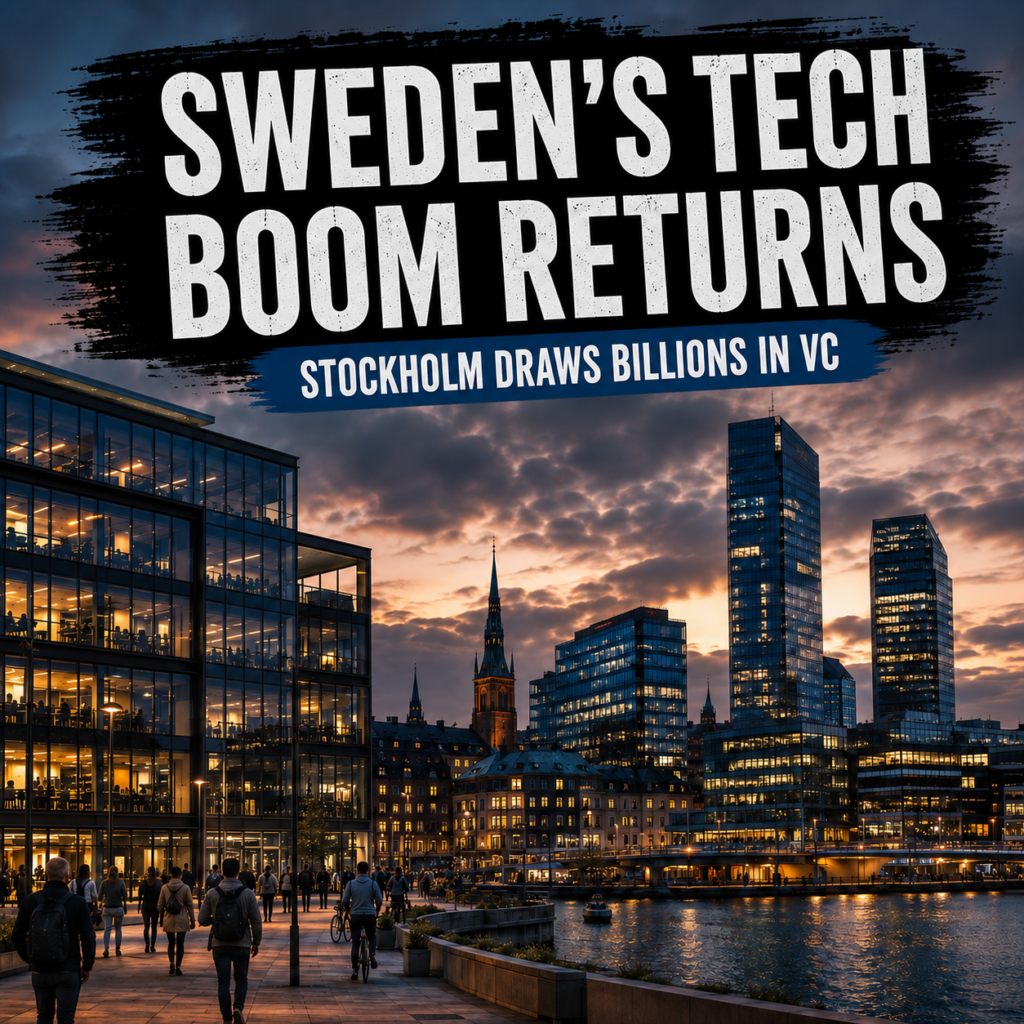
Sweden is becoming one of Europe’s leading technology hubs again
Sweden is experiencing another major technology upswing, and the current wave increasingly looks like more than the success of a few isolated companies. Swedish startups raised around $2.8 billion in venture funding during the first half of 2026, compared with approximately $3.2 billion during all of 2025. Dealroom estimates that, if the current pace continues, total funding for 2026 could approach $5.6 billion. That would still remain below the exceptional $8.5 billion raised during the record year of 2021, but the environment is completely different now. Capital is more expensive, investors are far more selective, and companies are expected to demonstrate real revenue, strong growth and a credible path toward building sustainable international businesses.Stockholm has changed particularly noticeably. After the generation that produced Spotify and Klarna, the Swedish capital is now home to another group of rapidly growing companies, including legal AI platform Legora, AI software developer Lovable, medical technology company Neko Health and autonomous electric transport developer Einride. At the same time, American venture capital firms are travelling to Stockholm more frequently. Only a few years ago, Swedish founders often had to travel to London, New York or San Francisco to seek major international funding. Now the situation is increasingly reversed, with investors coming directly to Stockholm because they do not want to miss the next major European technology company.