Search results
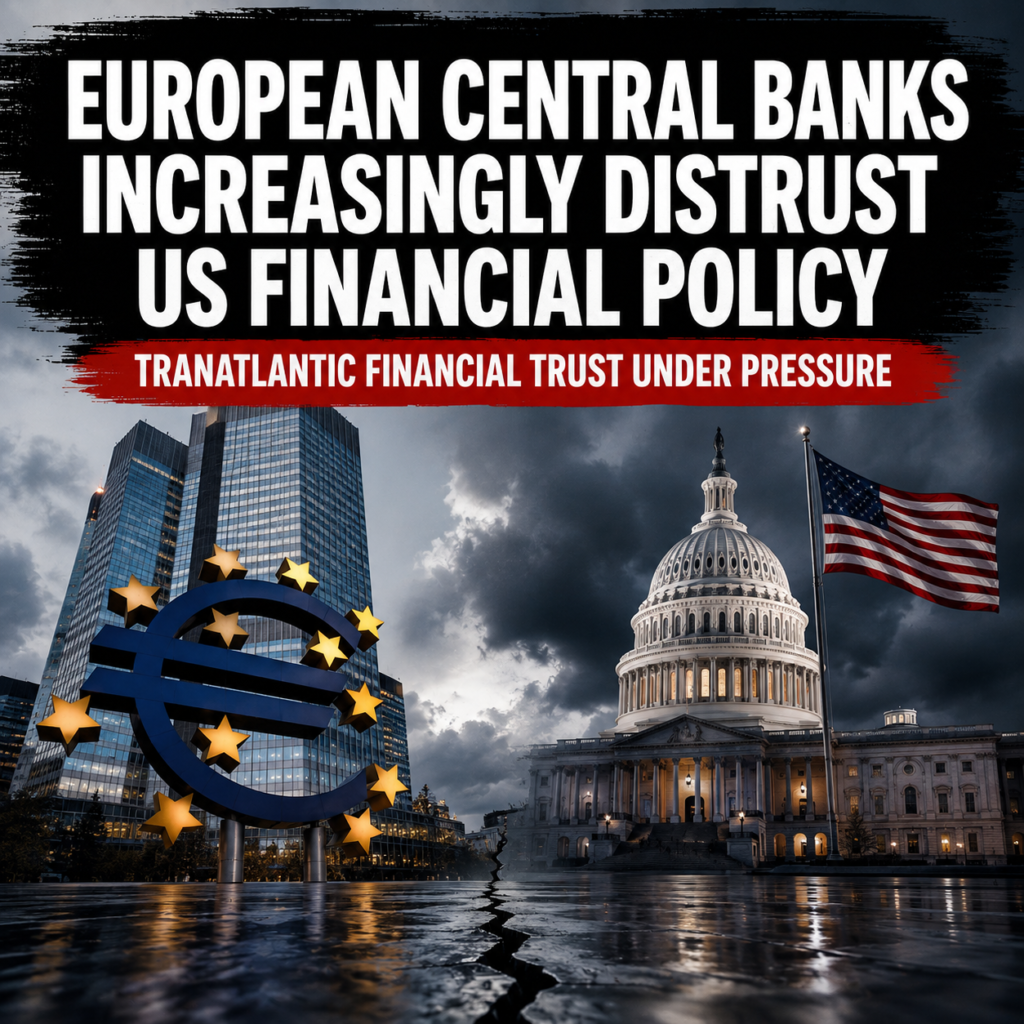
European central banks increasingly distrust US financial policy after Jackson Hole
European central bankers are beginning to discuss openly a risk that would have been almost unthinkable only a few years ago: some of the mechanisms at the core of the transatlantic financial system can no longer automatically be treated as politically untouchable. After the annual Jackson Hole gathering, concerns intensified over the growing unpredictability of US financial policy, particularly the possibility that Washington could use currency operations, Treasury-market interventions and other instruments not merely for technical stabilisation but as tools of broader economic and political policy. For European officials, the issue is no longer simply whether the Federal Reserve raises or cuts interest rates. The deeper concern is whether the institutional framework surrounding the dollar remains as predictable and politically insulated as global markets have traditionally assumed.The most sensitive part of the discussion concerns mechanisms that exist precisely for moments of crisis. Dollar swap lines between major central banks allow institutions such as the European Central Bank, Bank of England and others to obtain dollars from the Federal Reserve and provide liquidity to their domestic banking systems when global demand for the US currency suddenly surges. These arrangements were crucial during the 2008 financial crisis and again during the pandemic. There is currently no indication that the Federal Reserve intends to dismantle them.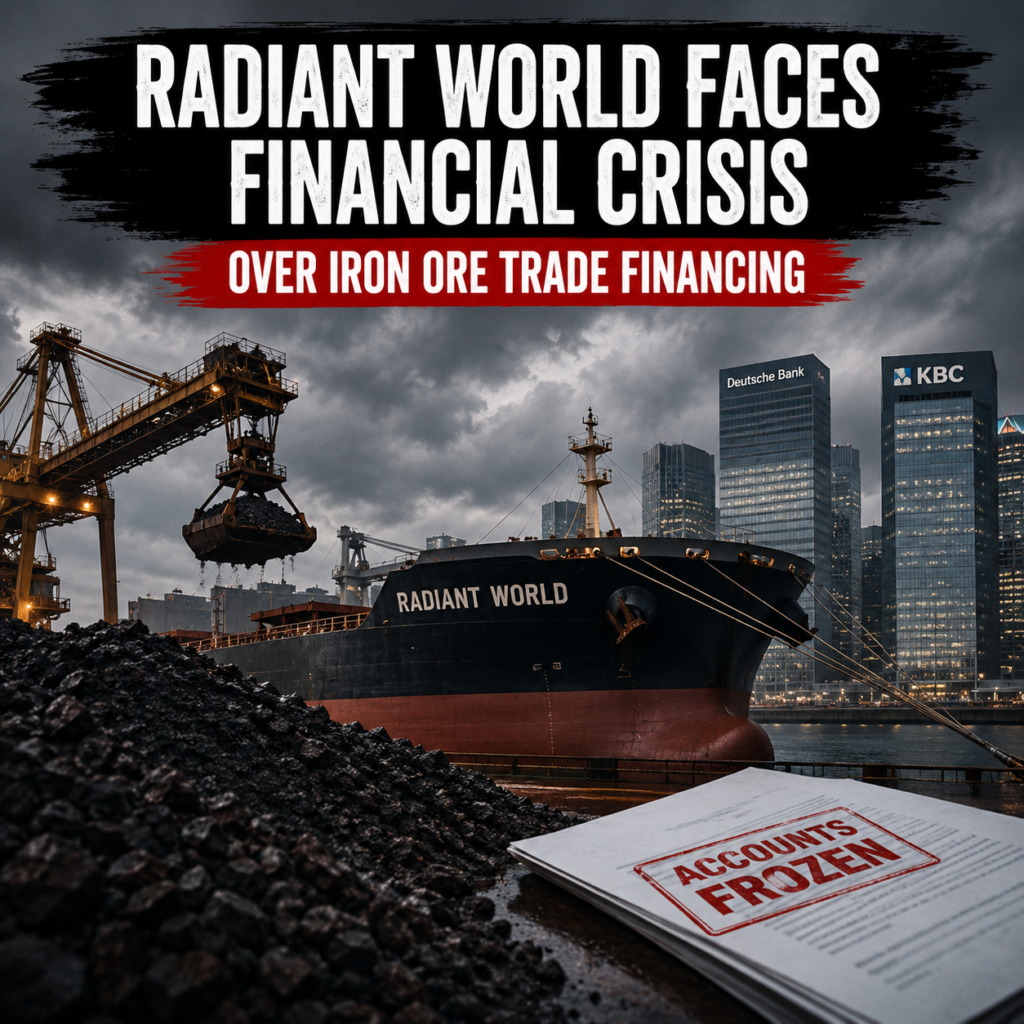
Radiant World faces growing financial crisis over iron ore trade financing
One of the world’s largest independent iron ore traders has become the centre of a financial story that could develop far beyond an ordinary corporate dispute. Singapore-based Radiant World, which says it handles more than 80 million tonnes of iron ore annually, is facing scrutiny following reports concerning potentially invalid documents used in trade-finance transactions. Its Singapore entity reported revenue of approximately $9.6 billion and net profit of $140.9 million for the financial year ending in September 2025. Banks, commodity companies and other counterparties have since begun restricting their exposure while authorities examine aspects of the group’s activities.The European dimension is particularly important. Deutsche Bank and Belgium’s KBC Group have frozen parts of Radiant World’s Singapore accounts while conducting internal reviews, while other financial institutions have restricted or suspended credit facilities. Major commodity companies have also reduced their dealings with the group. Radiant World strongly rejects allegations of wrongdoing, describing reports about irregularities as inaccurate and unsubstantiated and insisting that it maintains high commercial and legal standards. No wrongdoing has been established, but the scale of the company’s banking relationships means the case could become a major test for international commodity trade finance and the European banks that help fund it.
Italy’s banking war could completely redraw the country’s entire financial landscape
Italy is entering a banking battle worth tens of billions of euros that could fundamentally alter the balance of power in one of Europe’s largest financial systems. Monte dei Paschi di Siena has launched two simultaneous all-share takeover proposals worth roughly €34 billion in total: about €25.3 billion for Banco BPM and another €8.72 billion for Banca Generali. At the same time, MPS itself is under attack, with Italy’s largest bank, Intesa Sanpaolo, pursuing a hostile takeover worth approximately €30.6 billion. The result is an extraordinary situation in which a potential acquisition target is attempting to dramatically increase its own scale and create a more attractive alternative for shareholders before its rival can complete the takeover.Another important development has now changed the dynamics of the confrontation. Generali, which controls Banca Generali, has for the first time indicated that it is prepared to evaluate Monte dei Paschi’s proposal and consider its economic and commercial consequences, even though the transaction was not previously agreed with MPS. That turns what initially looked like an extremely ambitious defensive strategy by Monte dei Paschi chief executive Luigi Lovaglio into a potentially realistic restructuring of Italian finance.
British venture capital unexpectedly returns to record levels as foreign money pours in
Britain’s venture capital market is unexpectedly returning to the levels last seen during the technology boom of 2021. UK startups raised around £14.4 billion during the first half of 2026, putting the market on a trajectory that could exceed the previous annual record if investment continues at anything close to the same pace. Artificial intelligence, software and biotechnology are attracting the largest amounts of capital, with several exceptionally large rounds demonstrating that international investors remain prepared to commit billions to British technology companies despite several years of higher interest rates and much tighter financing conditions.The most striking part of the recovery, however, is where the money is coming from. British investors accounted for only around 11% of the capital deployed into UK startups, meaning that the overwhelming majority of financing again came from overseas. That creates a remarkable contradiction. Britain continues to produce some of Europe’s most attractive technology companies, scientific research and entrepreneurial teams, but its domestic investment system is capturing only a relatively small share of their growth. The country is therefore proving its ability to generate globally competitive technology while simultaneously demonstrating how dependent that technology ecosystem remains on American and other international capital.
Bertelsmann prepares for more major acquisitions after Sky Deutschland deal
Bertelsmann is preparing to continue one of its most aggressive acquisition cycles in years and could complete another one or two major transactions within the coming months. Chief Executive Thomas Rabe said on 28 August 2026 that the German media group intends to keep expanding through a combination of organic growth and acquisitions. The comments came shortly after RTL Group completed its purchase of Sky Deutschland, significantly strengthening Bertelsmann’s position in the German-speaking media market. The group is now looking well beyond Europe, with the United States, India, China and Brazil among the regions identified as important areas for further expansion.The financial position gives Bertelsmann room to move. Revenue for the first half of 2026 rose to about €9.3 billion, adjusted operating EBITDA increased to roughly €1.3 billion, and net income climbed sharply. The company also raised its outlook for the full year. Since 2021, Bertelsmann has already committed billions of euros to its Boost strategy, which combines acquisitions with investment in existing businesses. By the end of 2026, the total volume of those investments is expected to approach €10 billion, creating a substantial base for further large-scale deals.The most important recent transaction is the acquisition of Sky Deutschland by RTL Group, which is controlled by Bertelsmann. The deal was completed on 1 June 2026 after receiving unconditional approval from the European Commission.
German industry demands a much tougher government policy toward China
German business is becoming increasingly outspoken in demanding that Chancellor Friedrich Merz’s government change its trade policy toward China and make more aggressive use of European market-defence instruments. Industrial associations that only a few years ago warned Berlin about the risks of confrontation with Beijing are now pointing to the opposite danger: without tougher measures, European manufacturers could continue losing ground both inside China and in their own home market. Their central argument is that Chinese companies benefit from large-scale state support that allows them to expand production, lower prices and compete in Europe under conditions German industry increasingly considers structurally unequal.The shift is particularly important in the automotive sector, which for decades was one of the main forces restraining Germany from supporting a harder line against China. Volkswagen and other German carmakers built enormous businesses there and feared retaliation from Beijing, but the market structure has changed. Chinese brands are gaining share at home, expanding exports and becoming much stronger competitors in Europe itself. Germany’s trade deficit with China reached €89.3 billion in 2025, while the imbalance continued to widen in 2026. Pressure on Berlin is therefore no longer coming only from Brussels or from politicians worried about strategic dependency. It is increasingly coming from German industry itself.
Investors pull billions from US stocks while shifting fresh capital into Europe
Global equity funds recorded their first net outflow in 13 weeks, with investors withdrawing $5.87 billion during the week ended 26 August. The headline figure, however, hides a much more interesting movement underneath. US equity funds lost $22.33 billion, their largest weekly outflow since March 2026, while European funds attracted approximately $7.92 billion of new capital and Asian funds received another $4.8 billion. Investors were therefore not simply reducing exposure to equities as an asset class. A meaningful share of capital was moving away from the United States while continuing to seek opportunities in other regions.One week of fund flows does not prove the beginning of a long-term exodus from Wall Street, but the direction is increasingly significant given the extraordinary expectations surrounding the American artificial-intelligence boom. The S&P 500 remains close to record levels, and much of the market’s enthusiasm continues to depend on Nvidia and a relatively small group of technology giants. European equities have also risen strongly in 2026, but their structure is far less concentrated around a handful of AI leaders. For global investors looking to diversify portfolios without abandoning equities, Europe is becoming a more credible alternative to an increasingly expensive American market.The largest pressure was concentrated in US large-cap equity funds.
Google changes European search rules as EU pressure reshapes Big Tech business models
Google has changed how part of its search spam policy will operate across the European Economic Area following pressure from European regulators. The adjustment concerns the company’s site reputation abuse policy, which was created to stop third-party commercial content from using the authority of established websites to gain better positions in Google Search. From 30 August, some manual actions connected with this policy will no longer affect users in the 27 EU member states, Iceland, Norway and Liechtenstein in the same way as users elsewhere. Outside the European Economic Area, Google’s existing enforcement system will continue to operate, creating another example of a global technology product functioning differently inside Europe because of EU regulation.For business and financial markets, the significance of the decision goes far beyond a technical change to search rankings. One of the world’s largest American technology companies is effectively creating a separate operating regime for a core global service because European competition rules have made a single worldwide model increasingly difficult to maintain. The European Union is continuing to use the Digital Markets Act to force dominant digital platforms to alter products, commercial practices and relationships with competitors.
France’s Iliad Accelerates European AI Infrastructure Buildout as Scaleway Challenges US Cloud Giants
French telecommunications group Iliad is making an increasingly serious bet on building European artificial intelligence and cloud infrastructure. Its Scaleway division is growing by more than 50% a year and is gradually evolving from a relatively niche European provider into one of the most credible regional alternatives to Amazon Web Services, Microsoft Azure and Google Cloud. For Europe, this matters because the project is no longer about creating another software product or a single AI model. It is about building the physical infrastructure on which European companies, public institutions and artificial intelligence systems will increasingly depend.At the same time, Iliad is expanding the physical foundation of that business. Together with infrastructure investor InfraVia, the group intends to increase its European data-centre capacity to around 400 MW. At that scale, the network could exceed the current infrastructure capacity of OVHcloud and become one of the largest independent European cloud platforms. The strategy is not limited to France. Iliad already has major operations in Italy and Poland, allowing it to build a distributed infrastructure network capable of serving customers across several of the EU’s largest economies.The existing customer base is particularly important. Scaleway is no longer serving only startups and smaller developers. Major European corporations such as Airbus and LVMH are already among its clients.