
Search results
Pernod Ricard Loses Ground in the US and China as Shares Fall More Than 6%
French drinks group Pernod Ricard suffered another serious blow to its business after publishing annual results, with shares in the owner of Absolut, Martell, Jameson, Chivas Regal and other global alcohol brands falling by more than 6%. The market reaction was driven mainly by a sharp deterioration in two of the company’s most important countries. Sales in the United States fell by 14%, while sales in China declined by 19%. That is particularly painful because those two markets spent years delivering a significant share of growth in premium spirits and giving international producers room to keep pushing prices higher.Pernod Ricard is already responding with a large reduction in costs. The company has cut roughly 3,600 jobs and intends to complete its €1 billion restructuring and efficiency programme earlier than originally planned. At the same time, management is looking for new sources of growth and is considering an IPO of its Indian business, which is becoming increasingly important as the United States and China weaken. The shift inside one company captures a wider change in the global market: old premium-alcohol growth engines are losing momentum, while India and other faster-growing markets are becoming much more important.The problem extends well beyond Pernod Ricard. The global alcohol industry is going through a prolonged period of weak demand after several years of exceptionally strong sales.
Nvidia Agrees to Buy Hugging Face for $12.9 Billion, Securing a Key Layer of Global Open AI Infrastructure
Nvidia has agreed to acquire Hugging Face for $12.9 billion, taking control of one of the most important global platforms for developing, publishing and distributing open artificial intelligence models. The agreement was reported on 27 August 2026 by The Information, with Reuters subsequently confirming the report and the key parameters of the deal. Hugging Face generates only around $150 million in annual revenue, meaning Nvidia is paying a price that dramatically exceeds the company’s current commercial scale.The valuation becomes easier to understand if Hugging Face is viewed not as an ordinary technology startup but as one of the central infrastructure nodes of the global AI ecosystem. Millions of developers use the platform to discover, download, test and distribute models, datasets and development tools. Models from Meta, Mistral, DeepSeek and thousands of independent developers circulate through Hugging Face, while the Transformers library has effectively become one of the standard tools of modern AI development. Hugging Face itself says it now serves more than seven million users.For Nvidia, the acquisition means gaining control not over another individual model developer, but over an infrastructure layer positioned between AI creators, the models they use and the computing resources required to run those models. Nvidia already dominates the market for AI accelerators.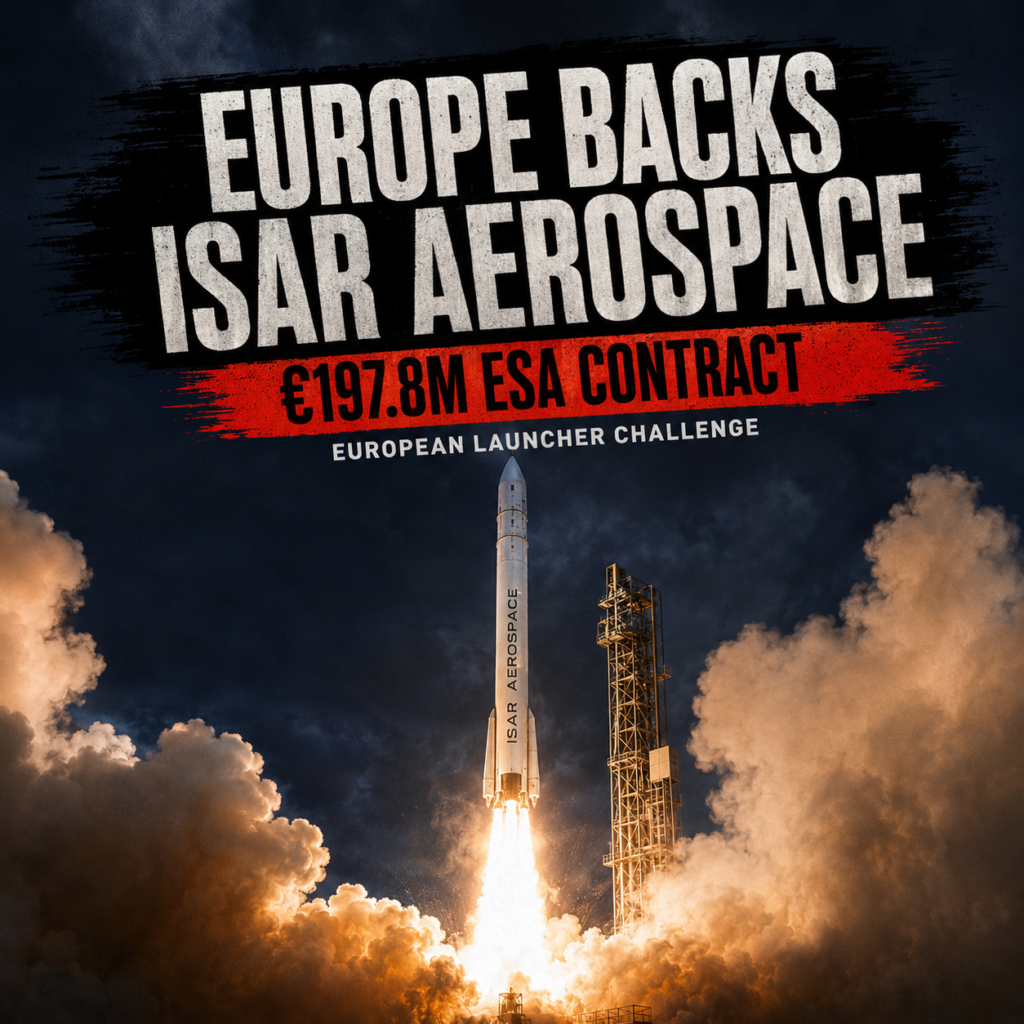
Europe Gives Isar Aerospace Nearly €200 Million as It Accelerates the Search for Its Own SpaceX Rival
German rocket company Isar Aerospace has secured a €197.8 million contract from the European Space Agency under the European Launcher Challenge, making it the largest contract awarded through the programme so far. Most of the financing comes from Germany, with additional support from Austria and Norway. The money is intended not simply to fund individual launches, but to help the company develop the next generation of its launch vehicles, expand testing and launch infrastructure and increase the frequency of future missions.The scale of the wider programme shows how seriously Europe is now treating independent access to space. ESA member states have allocated more than €900 million to the European Launcher Challenge in an attempt to create a competitive private European launch industry. The European Space Agency is effectively changing its own model: instead of developing every launch vehicle under direct state control, it is increasingly acting as a major customer for private companies, buying launch services while simultaneously helping them mature their technology and reach commercial scale.The strategic motivation is clear. Europe does not want to remain in a position where a significant share of its commercial and institutional satellite launches depends on SpaceX or other foreign operators.
UniCredit Moves Close to Controlling Commerzbank as Berlin Shifts From Resistance to Negotiations
Italian banking group UniCredit has pushed its long-running campaign for Commerzbank close to a decisive stage. Its stake has risen to almost 50%, giving the Italian lender enormous influence over shareholder decisions and making Berlin’s earlier strategy of political resistance increasingly difficult to sustain. The next major step is scheduled for 14 September 2026, when UniCredit CEO Andrea Orcel is due to meet Germany’s finance minister. The fact that direct talks are now taking place shows how much the balance has changed: the German government can no longer rely on public opposition alone and increasingly has to discuss the practical terms of a possible combination.For Germany, the issue is much more sensitive than a normal cross-border acquisition. Commerzbank is one of the country’s key lenders to business and is especially important to the Mittelstand, the vast network of medium-sized industrial and export companies that forms a central part of the German economic model. If UniCredit gains effective control, decisions on strategy, capital allocation, international expansion and the future structure of one of Germany’s most important business banks would increasingly be taken within a much larger Italian banking group.A combination of UniCredit and Commerzbank would create a banking group with more than €1.3 trillion in assets and could become one of the largest banking transactions in modern Europe.