Search results
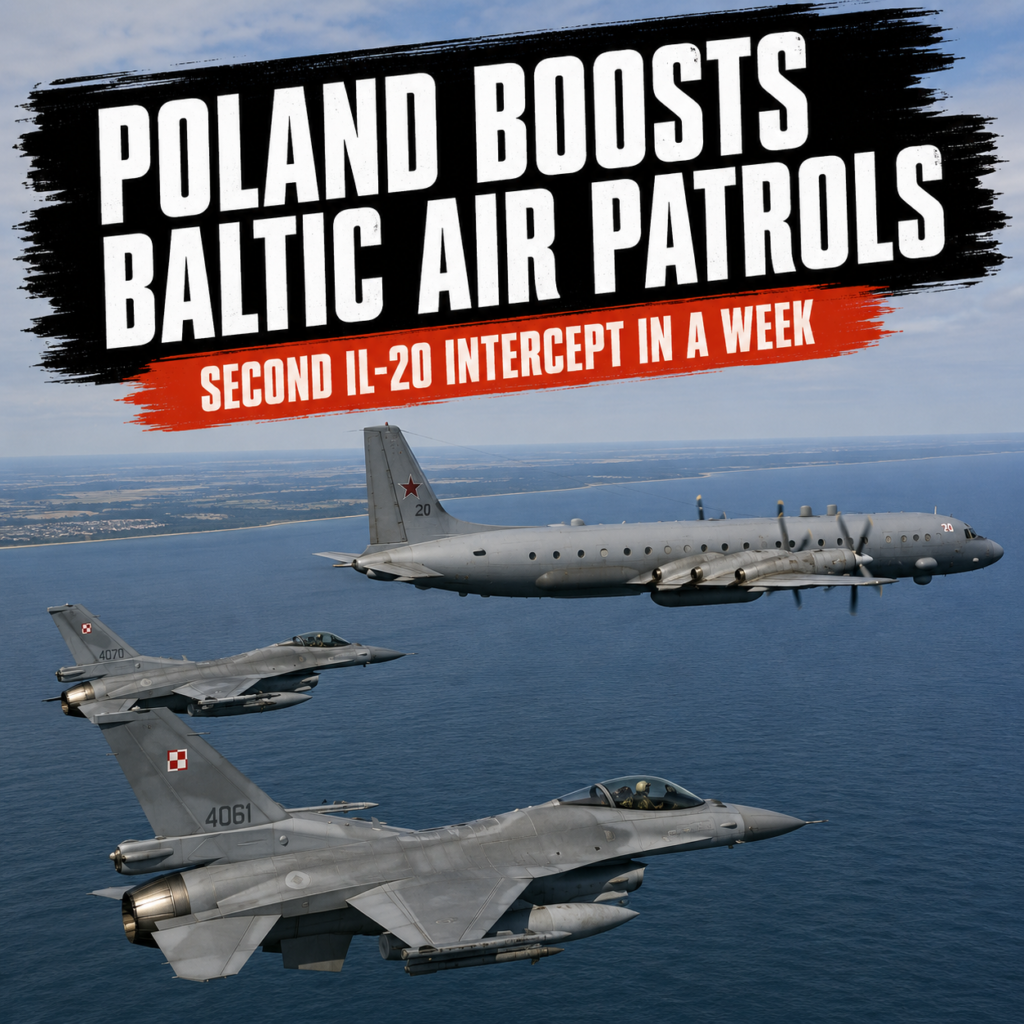
Poland Boosts F-16 Patrols After Second Intercept of Russian Il-20 Over Baltic
Poland is strengthening protection of its airspace following a series of incidents involving Russian military aircraft over the Baltic Sea. On 3 September 2026, Polish fighter jets intercepted a Russian Il-20 reconnaissance aircraft approximately 40 kilometres north of Ustka. Defence Minister Władysław Kosiniak-Kamysz said the Russian aircraft remained outside Polish airspace but was flying without active identification systems and, according to the Polish authorities, posed a risk to civilian aviation. No violation of Poland’s national airspace was recorded, meaning the incident was not an intrusion into Polish territory but an interception of a military aircraft operating in international airspace over the Baltic.The incident was the second of its kind within a single week and prompted Poland’s Defence Ministry on 3 September to announce stronger aerial patrols. Kosiniak-Kamysz said Poland would increase the activity of its air force, including F-16 fighters and helicopters, while also strengthening rapid-response systems against potential threats across the country. For Warsaw, repeated flights by Russian reconnaissance and combat aircraft close to the Polish coastline are increasingly becoming not isolated incidents but a permanent operational challenge for the country’s air surveillance and interception system.The previous incident occurred on 31 August, when Polish fighters intercepted another Russian Il-20 approximately 30 kilometres north of Łeba.
EU Halts Brazilian Meat Imports Amid Mercosur Dispute and Antibiotics Rules
The European Union effectively closed its market to several key animal products from Brazil on 3 September 2026 after the country failed to provide Brussels with the guarantees required under new EU rules on antimicrobial use. The restrictions primarily affect beef and poultry, as well as eggs, honey and natural casings used by the food industry. The measure was not triggered by a specific disease outbreak or by the discovery of a dangerous shipment. Instead, it reflects the lack of sufficient confirmation that Brazilian export chains fully comply with European restrictions on the use of certain antibiotics for growth promotion and with other rules governing veterinary medicines.The decision carries particular political significance because of the continuing dispute over the EU–Mercosur trade agreement. European farming organisations have argued for years that the deal could increase imports of cheaper South American agricultural products produced under standards that differ from those imposed on EU farmers. The European Commission has now effectively demonstrated that access to the EU market depends on more than tariff agreements alone: if a country cannot prove compliance with sanitary and veterinary requirements, trade preferences do not automatically guarantee continued access.The new requirements form part of the EU’s broader policy against antimicrobial resistance.
Danish Intelligence Says Russia Is Preparing Sabotage Against Defence Companies
Denmark’s Security and Intelligence Service, PET, says Russian intelligence services are actively preparing sabotage operations against Danish defence companies, particularly businesses connected to military support for Ukraine. According to Emil Gresholm, head of counterintelligence at PET, the threat has moved beyond a general assessment of what Russia might potentially do and now involves sufficiently concrete preparatory activity for Danish authorities to take it seriously. Possible scenarios mentioned by PET include arson as well as gathering information about access to industrial sites, security arrangements and other details that could later be used in preparing sabotage operations.A particularly important element of the new assessment concerns the methods Russia is allegedly using to organise such activity. Danish intelligence says Russian services are attempting to recruit ordinary citizens through social media, gaming platforms and other online channels. Potential recruits may initially be offered apparently harmless tasks, such as photographing a factory, checking access routes to a site or reporting where security personnel are positioned. Denmark increasingly views this as part of a broader European challenge involving the protection of defence production and infrastructure amid investigations into fires, attacks and other suspicious incidents across several EU countries.According to Gresholm, Danish companies have already appeared in specific Russian planning activities.
Russian Drone Strikes Coca-Cola Plant Near Kyiv After Brand’s Exit From Russia
A Russian drone struck the Coca-Cola Beverages Ukraine plant in Velyka Dymerka, in the Brovary district of the Kyiv region, on 3 September 2026. According to preliminary information, the strike hit warehouse facilities containing finished products, after which a major fire broke out at the site and thick black smoke rose above the industrial area. Initial reports indicate that no one was killed at the plant itself, although the full extent of the damage is still being assessed. The facility is one of Coca-Cola’s largest production sites in Europe and operates 11 production lines supplying beverages to the Ukrainian market.The strike acquired an additional symbolic dimension because of Coca-Cola’s history in Russia. The Coca-Cola Company suspended its business in the country after Russia’s full-scale invasion of Ukraine, while production and sales of Coca-Cola, Fanta, Sprite and other international brands were halted in 2022. Following reports of the attack, a sarcastic joke appeared suggesting that Russia had decided to “take revenge on Coca-Cola” for leaving the Russian market. This is, of course, a strange assumption: there is no evidence that such a motive was behind the attack. What is established is that the Russian strike hit a major civilian food-industry facility, and there is currently no information indicating that the site had any military purpose.The factory is located in Velyka Dymerka, several dozen kilometres from Kyiv, and has been operating since 1998.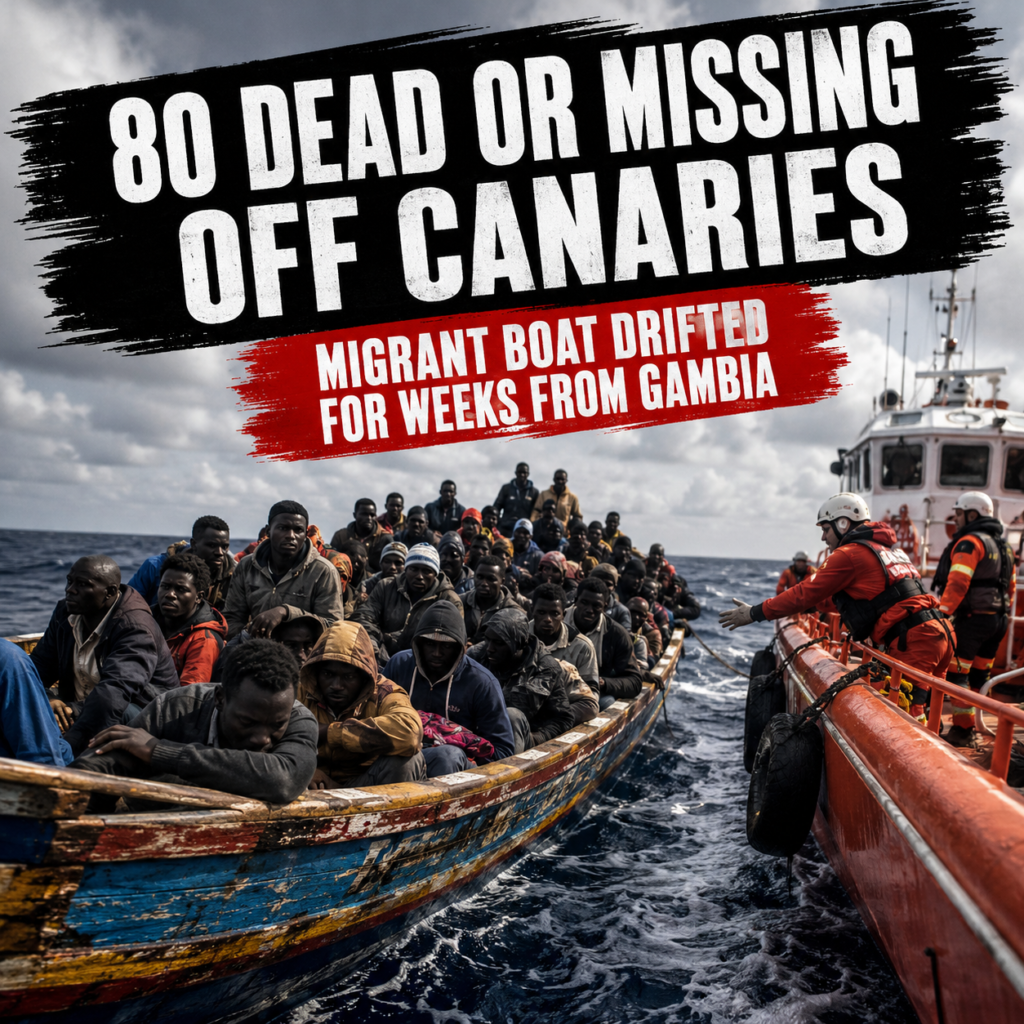
More Than 80 Migrants Dead or Missing After Boat Drifts Toward Canaries
One of the deadliest migration tragedies in recent months has unfolded near the Canary Islands. A wooden boat that departed from Gambia with 128 people on board spent almost four weeks in the Atlantic before being located south of Gran Canaria. Spain’s maritime rescue service found 44 survivors on board, many of them dehydrated and disoriented after a prolonged period without adequate supplies of food and water. Five bodies remained in the boat, but difficult sea conditions prevented rescuers from recovering them immediately. According to the Spanish NGO Caminando Fronteras, more than 80 of the people who had originally been on board died or remain missing.The tragedy has once again drawn attention to the Atlantic migration route from West Africa to the Canary Islands, which remains one of the most dangerous irregular migration routes into Europe. Unlike shorter crossings in the Mediterranean, this route runs through open ocean, where small overloaded boats can remain without assistance for weeks. In this case, the vessel reportedly left Gambia on 7 August 2026 and was not located until early September. The incident highlights not only the scale of the human losses but also the problem of so-called invisible shipwrecks, where the true number of victims can only be reconstructed from survivor testimony and information provided by families of the missing.The boat was detected by an aircraft operated by Spain’s Salvamento Marítimo around 120 kilometres southwest of Arguineguín on Gran Canaria.
Most Britons Agree With Burnham That Brexit Was a Wrong Turn for Britain
A majority of people in the United Kingdom now share Prime Minister Andy Burnham’s view that Brexit was a wrong turn for the country. According to a YouGov poll published on 2 September 2026, 55% of Britons believe leaving the European Union was the wrong direction, while 21% still regard it as the right one. Another 11% take a neutral position and 13% remain unsure. The figures appeared immediately after Burnham’s first speech in the House of Commons as prime minister, where he linked Britain’s weak economic performance and stalled regional development to a series of political decisions stretching back over several decades.Burnham’s argument did not begin with Brexit alone. He pointed to centralisation of political power, privatisation, deindustrialisation and later austerity as part of a longer sequence of decisions that weakened large parts of the country. Brexit, in his assessment, added another layer of economic damage and contributed to years of weak growth. The political importance of the speech lies in the fact that a British prime minister can now openly describe Brexit as part of the problem while having majority public support for that assessment. Burnham has not proposed immediate re-entry into the European Union, the single market or the customs union, meaning the debate is shifting toward how closely Britain should rebuild economic relations with Europe.Burnham made the remarks in his first House of Commons appearance as prime minister on 1 September.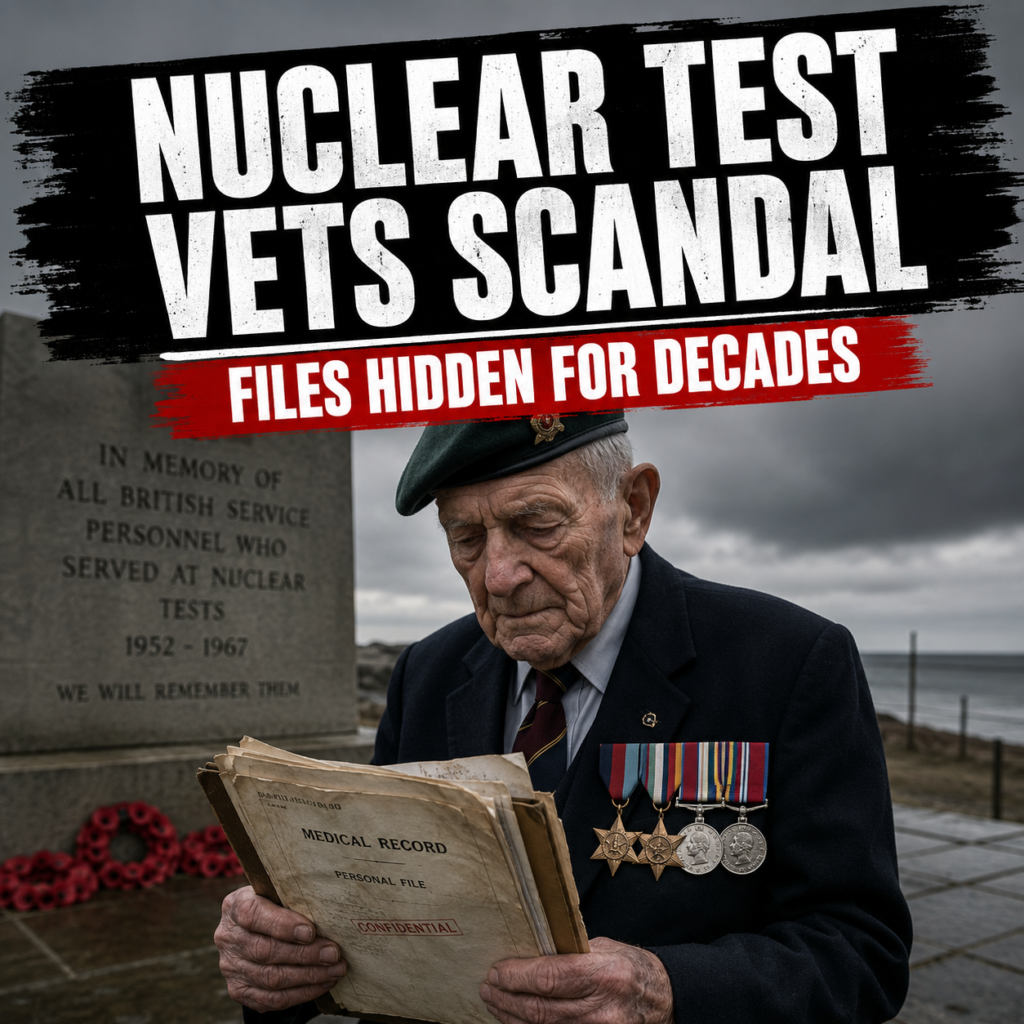
British Nuclear Test Veterans Demand Compensation After Former Defence Minister Admits Parliament Was Misled
Former UK defence minister Tobias Ellwood has admitted that he unintentionally misled Parliament in 2018 about medical records relating to servicemen involved in Britain’s nuclear weapons testing programme. The case concerns around 22,000 British military personnel, scientists and civilian specialists who took part in nuclear tests between 1952 and 1967 in Australia and the Pacific. Britain’s first atomic device was tested on 3 October 1952 near the Monte Bello Islands, followed by further tests at Emu Field and Maralinga in Australia and around Malden Island and Christmas Island in the Pacific.Many participants later reported cancers and other serious illnesses and spent decades trying to obtain medical records that might show whether they had been exposed to dangerous levels of radiation. Blood and urine tests became a central part of that dispute. In 2018, Ellwood told Parliament that the Ministry of Defence had been unable to find information showing that such tests had been conducted for radiological monitoring. He now says that statement was inaccurate because he himself had been given incomplete information by officials.It later became clear that records connected with blood and urine testing did exist. The Atomic Weapons Establishment held material containing results and information linked to medical monitoring of people involved in the nuclear programme.
Bosnia and Herzegovina Opens Election Campaign Amid Busy European Political Autumn
Bosnia and Herzegovina officially begins its election campaign on 4 September 2026 ahead of the general elections scheduled for 4 October. The Central Election Commission has warned political parties, candidates, supporters and media organisations that campaign rules will be enforced, with particular attention to hate speech, discriminatory statements and rhetoric capable of encouraging hostility or violence. The campaign will run until 3 October, when the election silence period begins. In a country where political institutions remain closely connected to ethnic representation and the complicated balance between Bosniaks, Serbs and Croats, the tone of the campaign is not simply a procedural issue but an important element of political stability.The Bosnian campaign is also beginning during an unusually active period for national elections elsewhere in Europe. Sweden will vote on 13 September, Latvia will elect a new Saeima on 3 October, and Bulgaria will hold its presidential election on 25 October. These campaigns are not politically connected, but their proximity creates a period in which several very different parts of Europe are entering decisive national political contests within only a few weeks. Each country is dealing with its own domestic issues, yet security, digital campaigning, political transparency and public trust are becoming increasingly prominent themes across all of them.
Names of Suspects Emerge in Leipzig/Halle Investigation After Arrests in Serbia
The investigation into the attempted drone attack involving explosives at Leipzig/Halle Airport has produced the names of two people now being examined for possible links to the operation. Serbian police arrested Danilo B., who holds Serbian and Russian citizenship, and Serbian citizen Slobodan D. near the Hungarian border on 11 June. Their vehicles contained components of a modified drone, control equipment and concealed containers with explosive material. German investigators are now examining whether the two men were connected to individuals considered central suspects in the Leipzig/Halle case and whether they may have played a role in moving equipment or supporting a wider sabotage network.The publication of the names, together with the physical evidence recovered in Serbia, gives the case a much more concrete dimension than the earlier reports about an unexplained drone near a Ukrainian aircraft. Danilo B. and Slobodan D. remain in custody in Serbia, while German investigators are comparing the technical characteristics of the seized material with the drone found at Leipzig/Halle. According to European reporting and security sources, investigators are particularly interested in similarities involving the way explosive material was packed inside metal containers. Germany has already publicly blamed Russian state structures for the attempted attack, while Moscow rejects the accusation and says the case has been fabricated.