Search results
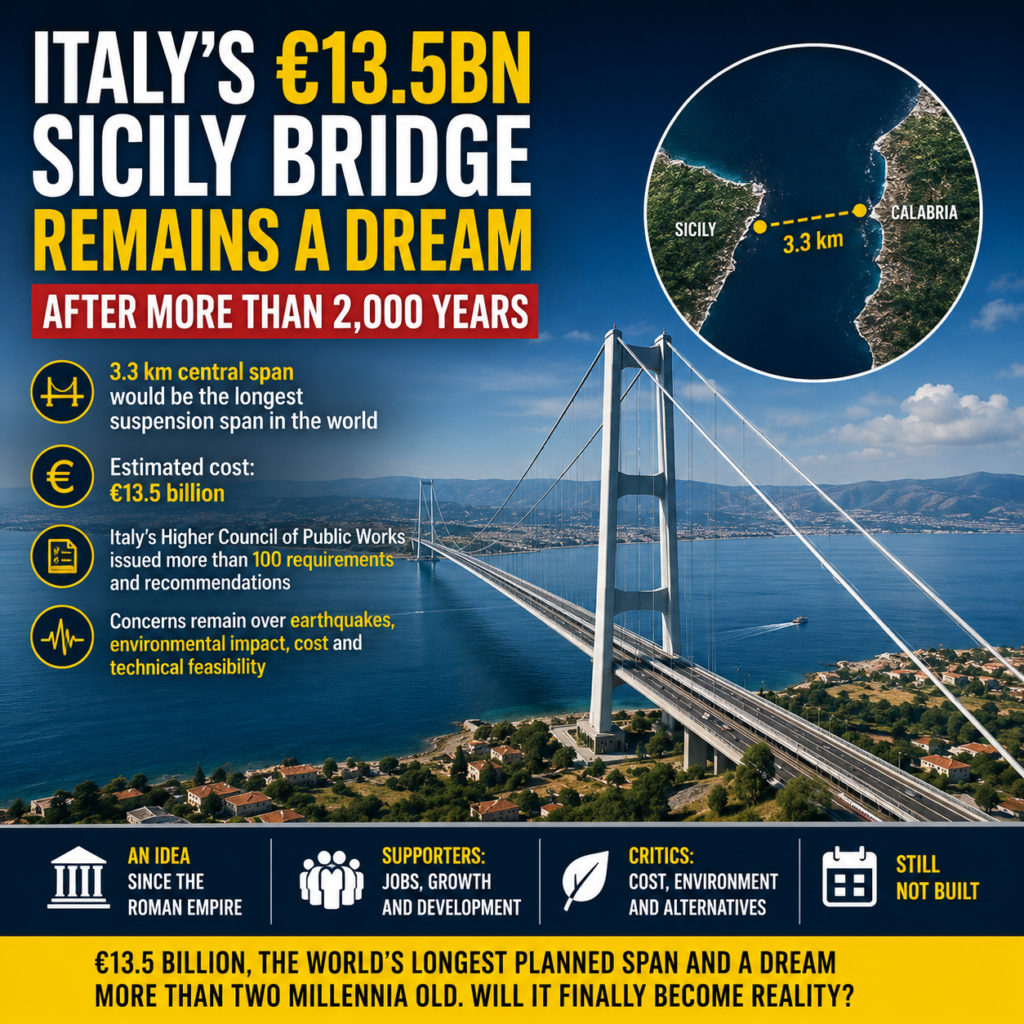
Italy’s €13.5 billion Sicily bridge remains a dream after more than 2,000 years
Italy is once again moving closer to building a bridge across the Strait of Messina, connecting Sicily with the mainland. The project is estimated to cost around €13.5 billion, but actual construction has still not begun.If completed, its 3.3-kilometre central suspension span would be the longest in the world. The full structure would stretch roughly 3.7 kilometres and carry both road and rail traffic.But major technical questions remain. Italy’s Higher Council of Public Works has allowed the project to move to the next stage while issuing more than 100 requirements and recommendations, including further checks on seismic risk, geology, materials and structural design.The Strait of Messina lies in a highly seismic area. Critics also point to environmental concerns, the enormous cost and the question of whether the money would be better spent on railways, roads and other infrastructure in Sicily itself.Supporters argue that the bridge could transform transport in southern Italy, boost investment and create thousands of jobs.The most striking part of the story is how old the idea itself is. Plans to connect Sicily with the mainland date back to the Roman era. Governments have changed, engineering has advanced and billions have been discussed — but the bridge still exists mainly on paper.€13.5 billion, the world’s longest planned suspension span and a dream more than two millennia old. The question remains the same: will Italy finally build it?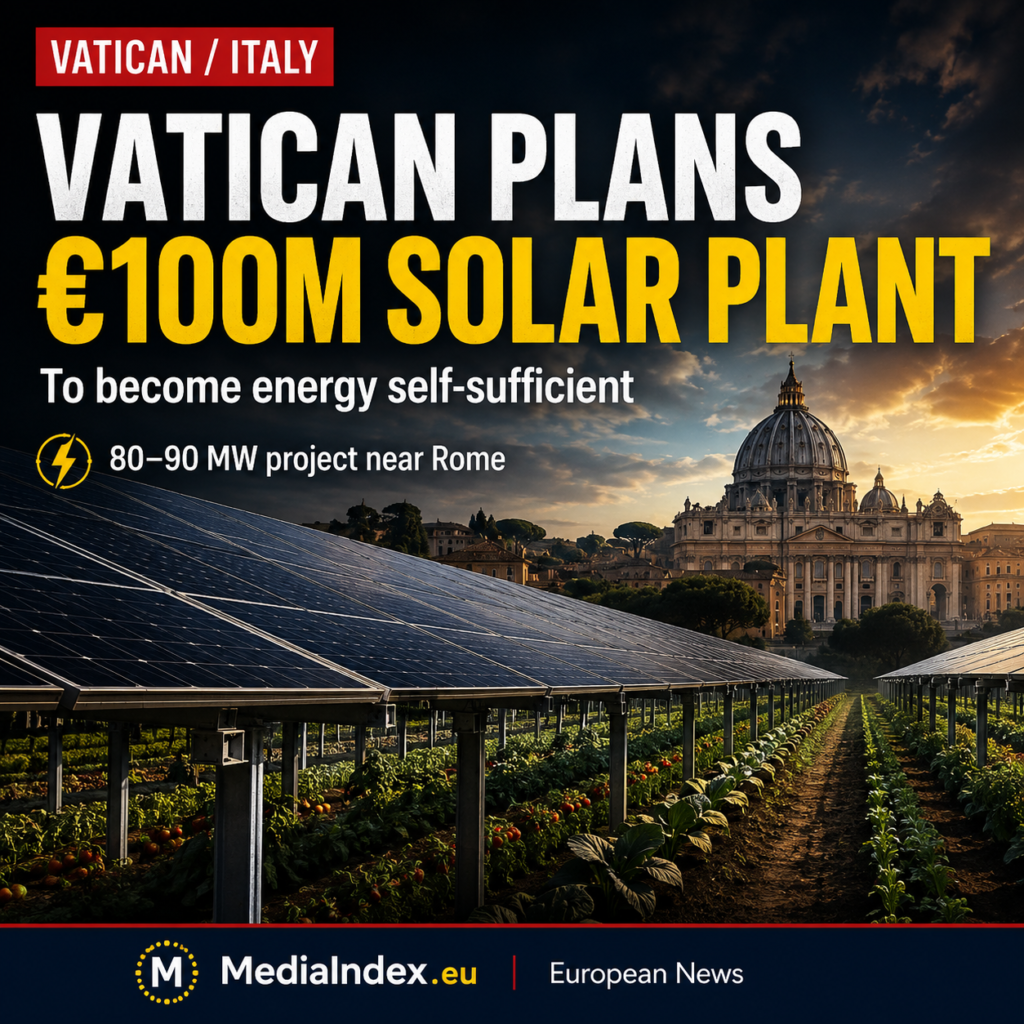
Vatican to build €100 million solar power plant and become energy self-sufficient
The Vatican is preparing one of Europe’s most unusual energy projects — a large agrivoltaic power plant at Santa Maria di Galeria near Rome. According to Reuters, the project will cost around €100 million and have a capacity of 80–90 MW. Solar panels will be installed across roughly 200 hectares of agricultural land, while farming will continue underneath them. The main goal is to supply electricity to Vatican Radio, Vatican City itself and related facilities. Any surplus power is expected to be fed into the Italian electricity grid. The project is intended to make the world’s smallest state effectively energy self-sufficient. The initiative was launched under Pope Francis and has been continued under Pope Leo XIV. The world’s smallest country is preparing to generate more clean electricity than it needs — and send the surplus to Italy.
🌍 🇬🇧 Strongest El Niño could make 2027 the hottest year on record — and reshape where people choose to live in Europe
The UK Met Office is warning that the developing El Niño could become one of the strongest ever recorded. Some forecasts suggest sea-surface temperatures in the equatorial Pacific could rise by more than 3°C above normal.One possible result: 2027 could become the hottest year ever recorded globally. For Europe, the effects would vary. Northwestern Europe could face wetter, windier and stormier conditions, while the broader global climate continues to warm.But climate change is already affecting more than the weather — it is beginning to change the geography of personal choice.After repeated extreme heatwaves in Spain, Italy, Greece and Portugal, more Europeans are choosing Scandinavia and other cooler northern destinations during summer. So-called coolcations have become a noticeable travel trend, with demand for Nordic destinations rising sharply.The next question is much bigger than tourism.If summer temperatures in southern Europe regularly approach 40–45°C, choosing a cooler region may gradually stop being only about holidays. Climate could increasingly influence decisions about second homes, property purchases, remote work and eventually permanent residence.There is not yet enough evidence to claim that Europeans are moving en masse to Scandinavia or the Baltic states specifically because of extreme heat.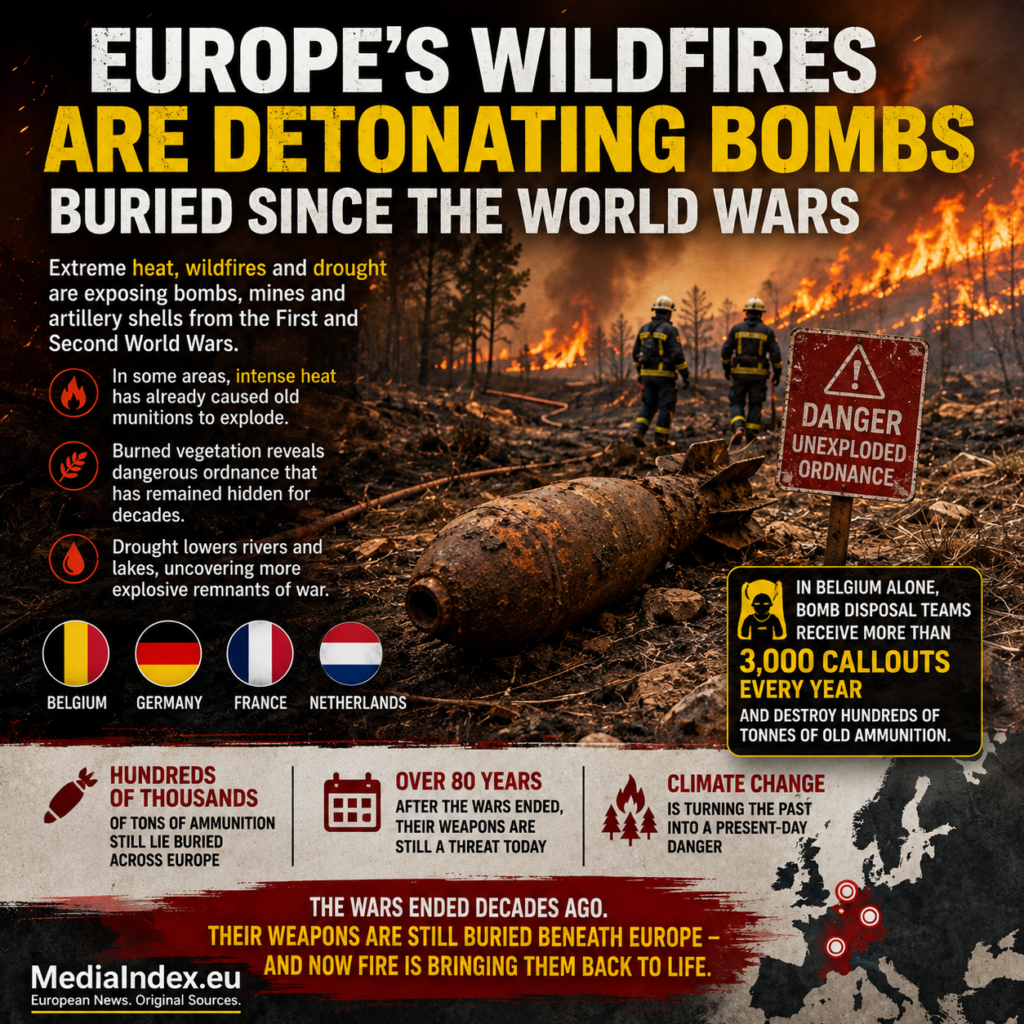
🔥 🇪🇺 Europe’s wildfires are detonating bombs buried since the world wars
Wildfires, extreme heat and drought across Europe are creating a new danger: bombs, mines and artillery shells left behind from the First and Second World Wars are being exposed again.In some areas, intense heat has already caused old munitions to detonate. Incidents have been reported in France, Belgium, Germany and the Netherlands, especially in regions that saw heavy fighting during the world wars.The problem goes beyond the fires themselves. Burned vegetation exposes ammunition that has remained hidden for decades, while drought lowers river and lake levels, revealing more unexploded ordnance.Belgium is particularly affected. Bomb-disposal teams receive more than 3,000 callouts every year and destroy hundreds of tonnes of old ammunition.Climate change is now adding a new layer of risk: extreme heat, dry soil and wildfires are making weapons buried for more than 80 years dangerous again.The wars ended decades ago. Their weapons are still buried beneath Europe — and now fire is bringing them back to life.🔗 MediaIndex.eu — European News. Original Sources.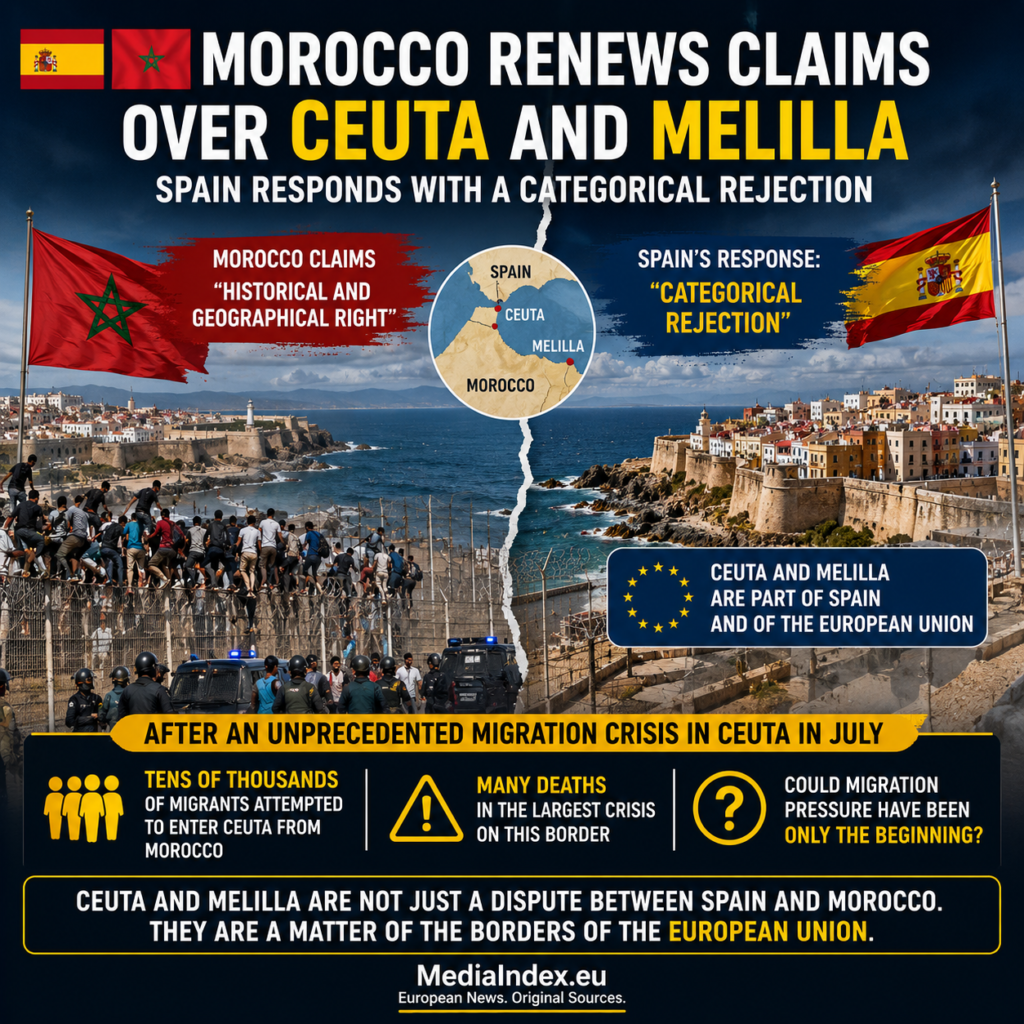
🚨 🇪🇸🇲🇦 Morocco renews claims over Ceuta and Melilla — Spain responds with a categorical rejection
Morocco has once again openly raised the issue of the future of Ceuta and Melilla — two Spanish cities on the northern coast of Africa that are also part of the territory of the European Union.Moroccan Justice Minister Abdellatif Ouahbi said Rabat considers the cities a matter of “historical and geographical right” and proposed creating a special bilateral mechanism with Spain, with the ultimate goal of bringing them under Moroccan sovereignty.Madrid responded firmly. The Spanish government issued a “categorical rejection” of any attempt to question Spanish sovereignty over Ceuta and Melilla, stressing that both cities are part of Spain and of the EU.But the statements come only weeks after an unprecedented border crisis. At the end of July, tens of thousands of migrants attempted to enter Ceuta from Morocco, triggering the largest crisis of its kind on this border and resulting in numerous deaths.And that raises a much bigger question.Could the mass migration pressure on Ceuta have been only the beginning?There is currently no proof that the July migration crisis was organised by Morocco as a tool of territorial pressure. But the sequence of events inevitably draws greater attention to relations between Madrid and Rabat: first, an unprecedented crisis on the EU’s external border — now, an open call to discuss the future of two Spanish cities.Ceuta and Melilla are no longer only a dispute between Spain and Morocco.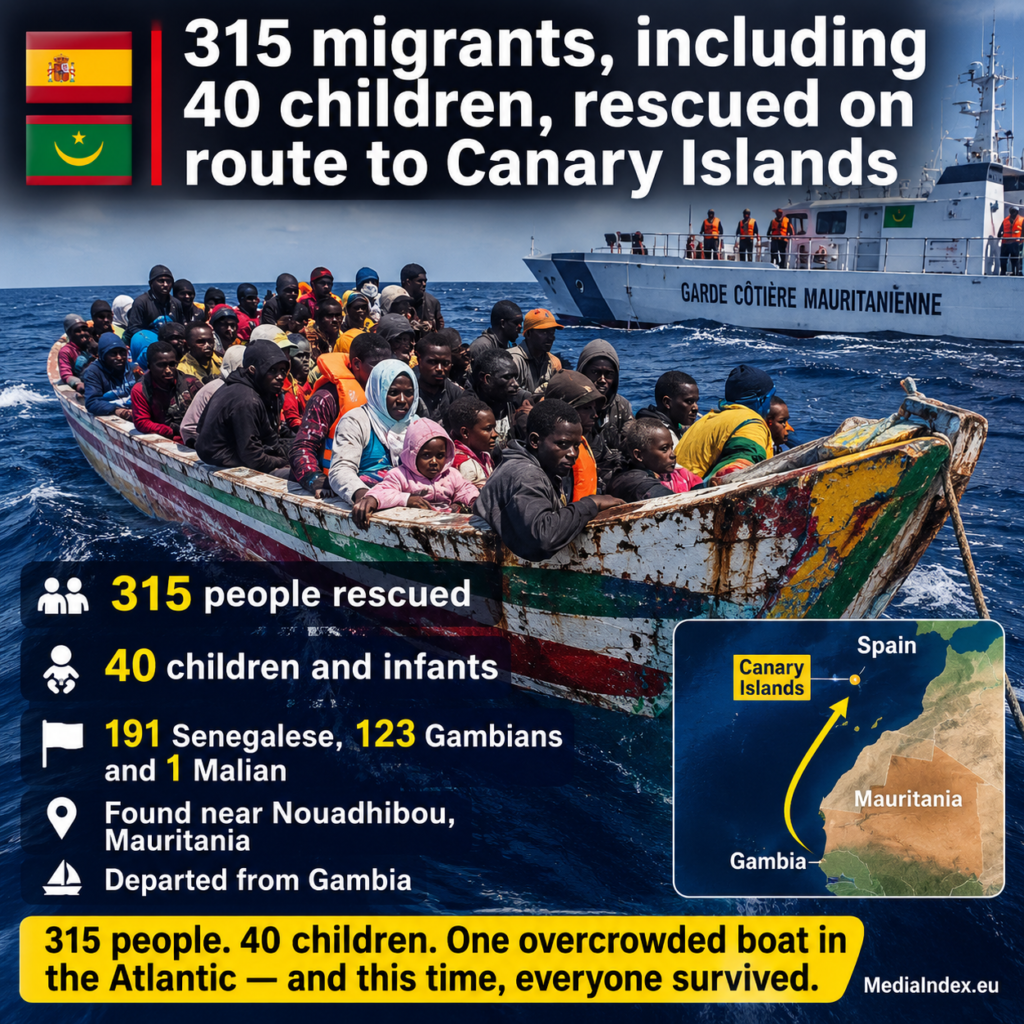
🚨 🇪🇸🇲🇷 315 migrants, including 40 children, rescued on route to Canary Islands
Mauritanian authorities rescued 315 people from an overcrowded wooden boat that had lost control off the country’s Atlantic coast.Those on board included 191 Senegalese nationals, 123 Gambians and one Malian. Among them were 40 children and infants.The boat had departed from Gambia and was found near Nouadhibou after several days at sea. By the time rescuers reached it, the vessel was drifting and those on board were in a vulnerable condition.The Atlantic route to Spain’s Canary Islands remains one of the most dangerous migration routes to Europe. Boats attempting the crossing often travel hundreds of kilometres across open ocean.In this case, all 315 people were rescued.315 people. 40 children. One overcrowded boat in the Atlantic — and this time, everyone survived.🔗 MediaIndex.eu — European News. Original Sources.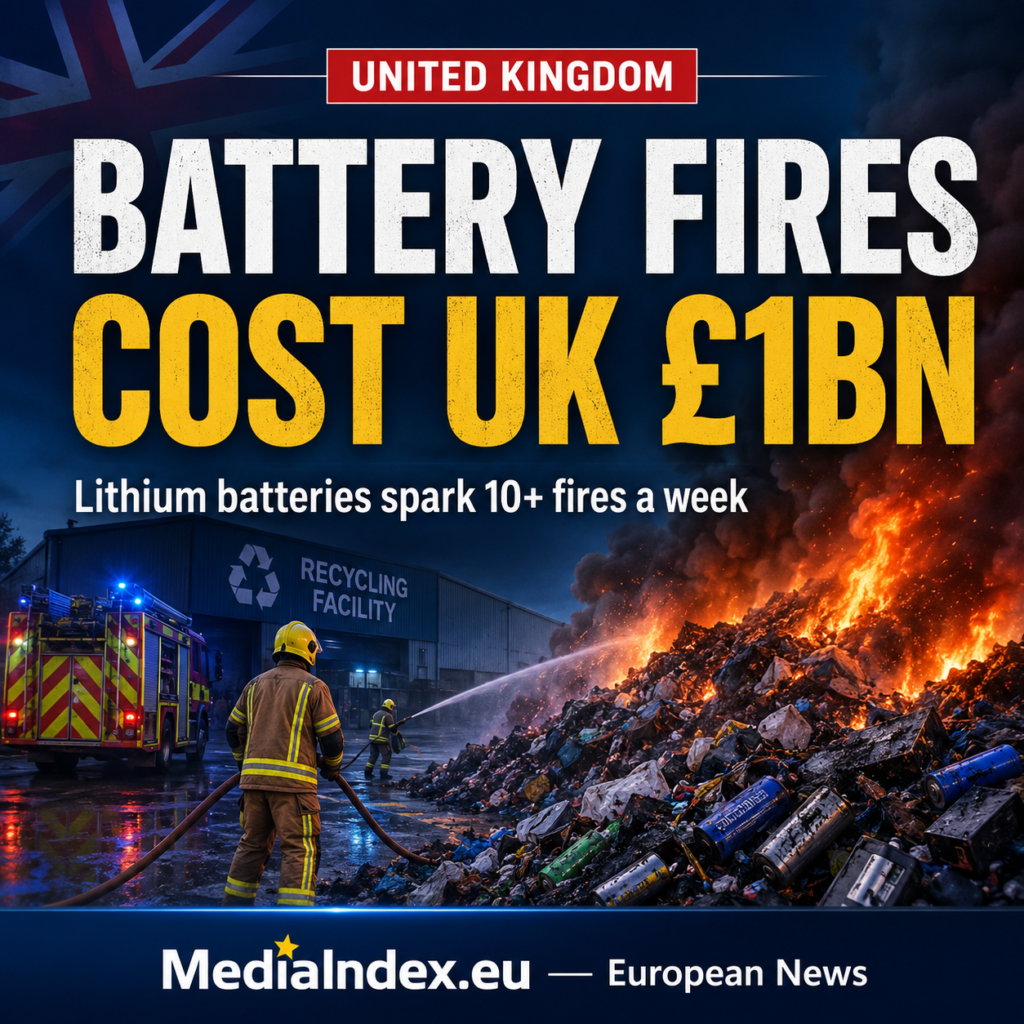
🔥 🇬🇧 Lithium battery fires are now costing the UK around £1 billion a year
The UK is seeing a sharp rise in fires at waste and recycling facilities linked to improperly discarded lithium-ion batteries.According to the Environmental Services Association, 1,518 fires were recorded across the sector between March 2025 and March 2026. At least 541 were directly linked to batteries — more than ten incidents every week. Another 216 fires occurred in refuse collection vehicles.The main risks come from batteries inside vapes, smartphones, toys and other electronic devices that are thrown away with normal household waste or recycling.When these batteries are crushed or damaged during processing, they can ignite almost instantly. Lithium-ion battery fires are particularly difficult to extinguish and can spread rapidly through waste facilities.Industry estimates suggest the overall cost of these incidents has risen from around £150 million in 2021 to about £1 billion a year today.Waste industry representatives are now calling for tougher battery disposal rules, including proposals such as a £5 deposit on vapes, refundable when the device is returned for proper recycling.A tiny battery thrown into the wrong bin can now trigger a multimillion-pound fire.🔗 MediaIndex.eu — European News. Original Sources.
🔥 🇬🇧 Lithium battery fires are now costing the UK around £1 billion a year
The UK is seeing a sharp rise in fires at waste and recycling facilities linked to improperly discarded lithium-ion batteries.According to the Environmental Services Association, 1,518 fires were recorded across the sector between March 2025 and March 2026. At least 541 were directly linked to batteries — more than ten incidents every week. Another 216 fires occurred in refuse collection vehicles.The main risks come from batteries inside vapes, smartphones, toys and other electronic devices that are thrown away with normal household waste or recycling.When these batteries are crushed or damaged during processing, they can ignite almost instantly. Lithium-ion battery fires are particularly difficult to extinguish and can spread rapidly through waste facilities.Industry estimates suggest the overall cost of these incidents has risen from around £150 million in 2021 to about £1 billion a year today.Waste industry representatives are now calling for tougher battery disposal rules, including proposals such as a £5 deposit on vapes, refundable when the device is returned for proper recycling.A tiny battery thrown into the wrong bin can now trigger a multimillion-pound fire.🔗 MediaIndex.eu — European News. Original Sources.🚨 🇹🇳🇮🇹 At least 13 missing after migrant boat sinks on route to Italy
At least 13 Tunisian nationals are missing after a migrant boat sank off the coast of Tunisia while attempting to reach Italy.The boat reportedly left early on Thursday morning. So far, only two people have been rescued. One of the survivors told rescuers they spent several hours in the sea after the boat capsized. The second rescued person is reported to be in critical condition.The central Mediterranean route remains one of the world’s deadliest migration paths. People from Africa and the Middle East continue to attempt the sea crossing to Europe, often on overcrowded and unsafe boats.In the past two years, departures from Tunisia have fallen significantly after tighter border and maritime controls backed by European support, including from Italy. But today’s tragedy shows that the deadly route has not disappeared.13 people missing. Two rescued. Another journey to Europe has ended in tragedy in the Mediterranean.🔗 MediaIndex.eu — European News. Original Sources.