Search results
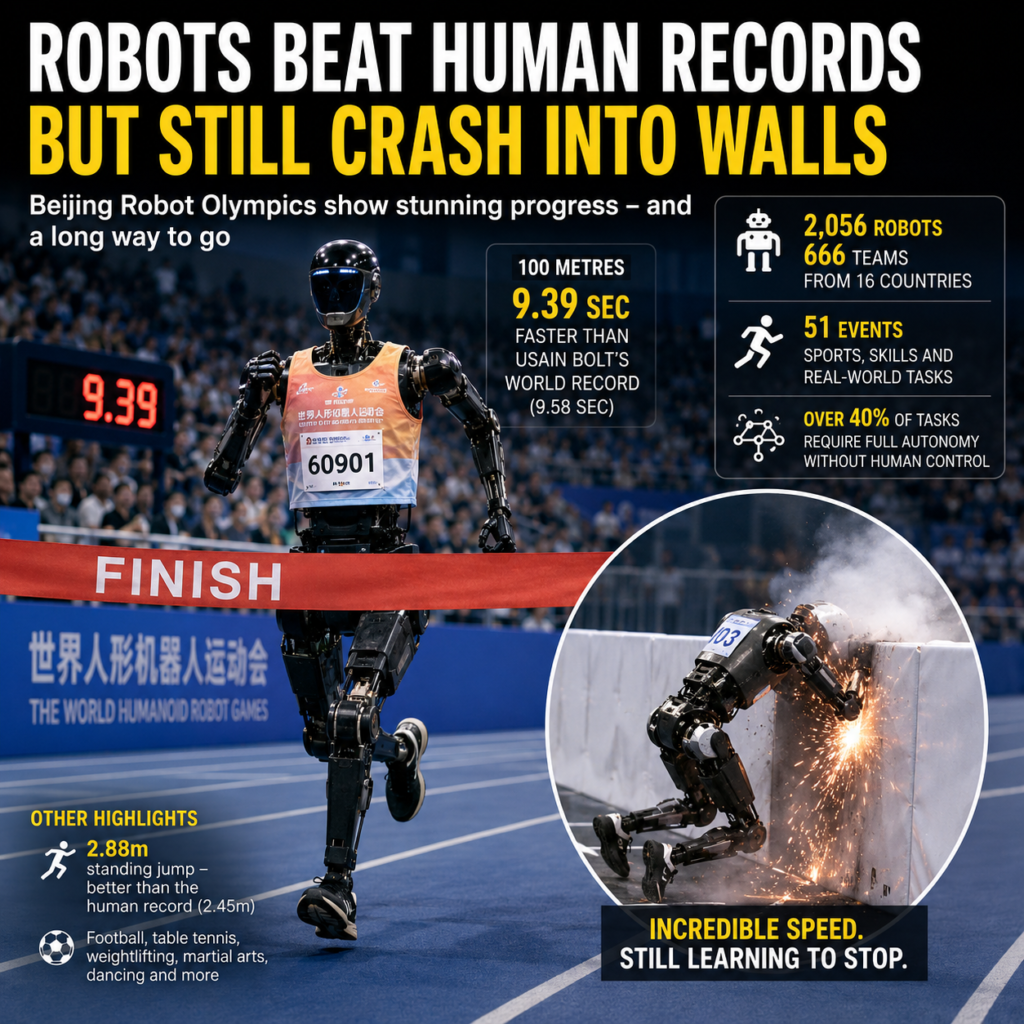
Robots are already running faster than humans — but they can still crash into a wall after the finish line
The World Humanoid Robot Games in Beijing have shown just how quickly modern robotics is advancing. A humanoid robot completed the 100 metres in 9.39 seconds — faster than Usain Bolt’s world record of 9.58 seconds.The result is impressive on its own, but the comparison with last year is even more striking. Back then, the best humanoid robot needed around 21.50 seconds to cover the same distance. In just one year, the performance has improved by more than half.At the same time, the competition is also exposing the limits of this rapid progress. After one high-speed race, a robot failed to slow down properly and crashed into a protective barrier at full speed. Sparks and smoke appeared after the impact.The incident is a surprisingly accurate picture of where robotics stands today. Machines are already capable of outperforming humans in specific physical tasks, while still struggling with situations that require simple adaptation to something unexpected.The same contrast can be seen in other events. Humanoid robots are running, jumping, playing football, performing martial arts and lifting weights. One robot recorded a 2.88-metre standing jump, surpassing the human record of 2.45 metres.But practical tasks are much more difficult. A machine capable of beating a human on a running track may take far longer to pick up an unfamiliar object correctly, insert a cable into a slightly misplaced socket, or regain balance after an unexpected movement.
Sydney Marathon mixes up Australia and Germany: Munich’s Allianz Arena accidentally appears on finisher medals
Organisers of the Sydney Marathon have admitted an unusual design mistake on the medals that will be awarded to participants in the 2026 race.The reverse side of the medal was supposed to show the marathon route and iconic Sydney landmarks. But instead of Sydney’s Allianz Stadium, designers accidentally used an image of Allianz Arena in Munich — home of Bayern Munich.The mistake was spotted by social media users, who began tagging Bayern Munich and the official Allianz Arena account.Organisers acknowledged the error, calling it “unfortunate,” but it is now too late to replace the medals. With the race just days away, more than 40,000 participants are expected to receive them anyway.In Munich, the mistake was met with humour, with the Allianz Arena account reacting to the unexpected appearance on an Australian marathon medal.Sydney Marathon is part of the prestigious Abbott World Marathon Majors series alongside Berlin, London, Boston, Chicago, New York and Tokyo.Ironically, the error may now make these medals far more memorable — and possibly more collectible — than the organisers ever intended.40,000 runners in Sydney — and a little piece of Munich on every medal.
UEFA turns against Infantino as Trump family connections enter FIFA sell-off controversy
UEFA President Aleksander Čeferin has effectively opened a new front against FIFA President Gianni Infantino, saying he is likely to face a serious challenger at the next FIFA presidential election following the backlash over plans to bring private investors into FIFA’s future World Cup revenues.The proposal involved creating a new commercial structure, FIFA Forward Enterprise, reportedly valued at around $20 billion, with up to 20% potentially sold to outside investors. The deal could have raised roughly $4.2 billion for FIFA.But one of the most striking elements of the story is the identity of a potential investor.According to the Financial Times, one of the key parties involved in discussions was Thrive Eternal, linked to American billionaire Joshua Kushner.Joshua Kushner is the brother of Jared Kushner, Donald Trump’s son-in-law.That means the controversy surrounding the possible partial commercialisation of FIFA has once again brought the circle around the US president into the picture.Infantino has already faced criticism over his unusually close relationship with Donald Trump. Čeferin has also criticised FIFA for failing to consult UEFA on major decisions, including the decision to award Trump the FIFA Peace Prize.Čeferin compared the private-investment proposal with the failed European Super League project — and said FIFA’s plan was even worse, because in his view “football would literally be sold.”
Italy to help build the White House’s new $400 million ballroom as American stone heads to Italian craftsmen
Despite recent disagreements between US President Donald Trump and Italian Prime Minister Giorgia Meloni, cooperation between the two countries continues — this time in an unexpected field: architecture and traditional craftsmanship.Limestone quarried in the US state of Indiana is being sent to Italy, where Italian specialists are expected to carve monumental columns for the White House’s new ballroom.The project is estimated to cost nearly $400 million. The new complex will cover more than 8,000 square metres, making it larger than the main White House building itself, and is expected to accommodate around 1,000 guests.The companies that will carry out the stonework have not yet been officially identified. However, Carrara in Tuscany is seen as one of the most likely locations because of its centuries-old tradition of marble and stone craftsmanship. Nearby Pietrasanta, another internationally renowned centre for sculptors and stoneworkers, is also being mentioned.The combination is striking: the stone will be American, but the craftsmanship will be Italian.The design includes Corinthian columns and other monumental architectural elements intended to echo the style of major government buildings in Washington.The White House says the project is being financed with private funds. Around $355 million has reportedly already been raised, with major exterior work expected to be completed by 2028.There is also a historical connection.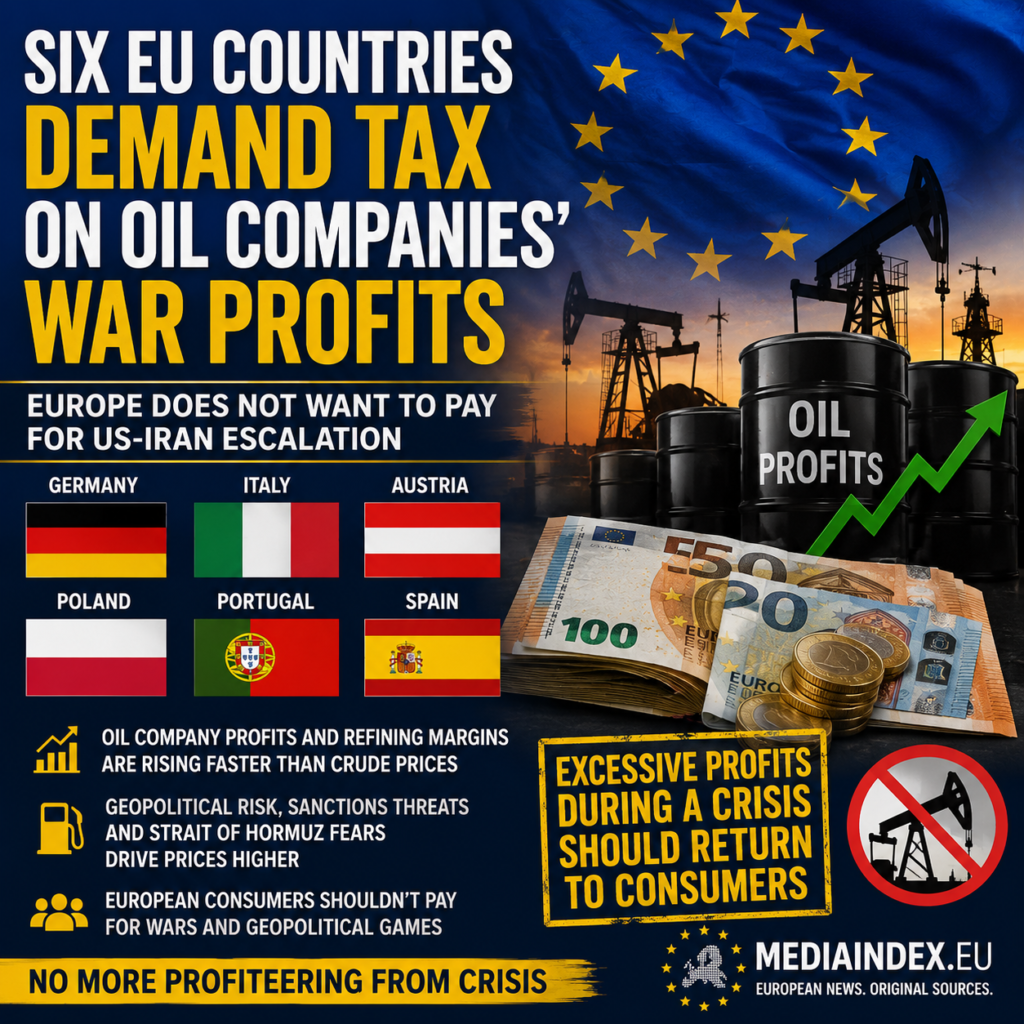
Six EU countries demand a windfall tax on oil companies: Europe does not want to pay for US-Iran escalation
Germany, Italy, Austria, Poland, Portugal and Spain are calling for an EU-wide tax on windfall profits made by oil companies.The six countries have sent a joint letter to Ireland, which currently holds the EU presidency, asking for the issue to be placed on the agenda of the next meeting of EU finance ministers.The reason is the sharp rise in oil-sector profits amid the continuing conflict involving the United States, Israel and Iran, as well as concerns over supplies through the Strait of Hormuz.But European ministers are pointing to an important detail: oil-company profitability and refining margins are rising faster than the price of crude itself. In other words, higher petrol and diesel prices cannot be explained solely by the cost of a barrel of oil.A large geopolitical risk premium is also being built into the market. Prices react not only to actual losses of oil supply, but also to almost every threat of new sanctions, military strike, statement from Washington or Tehran, and expectation of further disruption in the Strait of Hormuz.Fresh US threats of additional sanctions against Iran’s trading partners have again increased expectations of tighter supply and supported higher oil prices.At the same time, the physical oil market has not always experienced shortages large enough to justify the scale of the price swings.
Spain: famous “wolf boy” dies at 80 after spending 12 years almost entirely without human contact
Marcos Rodríguez Pantoja, the Spaniard whose extraordinary childhood made him famous far beyond his country, has died at the age of 80.He was born in Andalusia in 1946 into extreme poverty. At around six years old, his father handed him over to a shepherd in the Sierra Morena mountains. After the elderly shepherd died, Marcos was effectively left alone in the wilderness.For roughly the next 12 years, he lived with almost no contact with other people. According to his own accounts, he stayed close to a wolf pack, learned to understand animal behaviour and became able to imitate sounds ranging from birdsong to deer calls and wolf howls.Marcos said he gradually gained the wolves’ trust and came to see the animals as his family.In 1965, when he was 19, he was found by Spain’s Guardia Civil and brought back into human society. But returning to civilisation became one of the most difficult periods of his life.He later said repeatedly that he had felt happier in the mountains than among people. He struggled to adapt to money, social rules and human relationships.His story later became the subject of academic research. Anthropologist Gabriel Janer Manila studied his life in detail, and it eventually inspired the Spanish film “Entrelobos” — “Among Wolves.”In his later years, Marcos lived in the small Galician village of Rante, where local authorities said he had finally found a true home. He died on 15 August at the age of 80.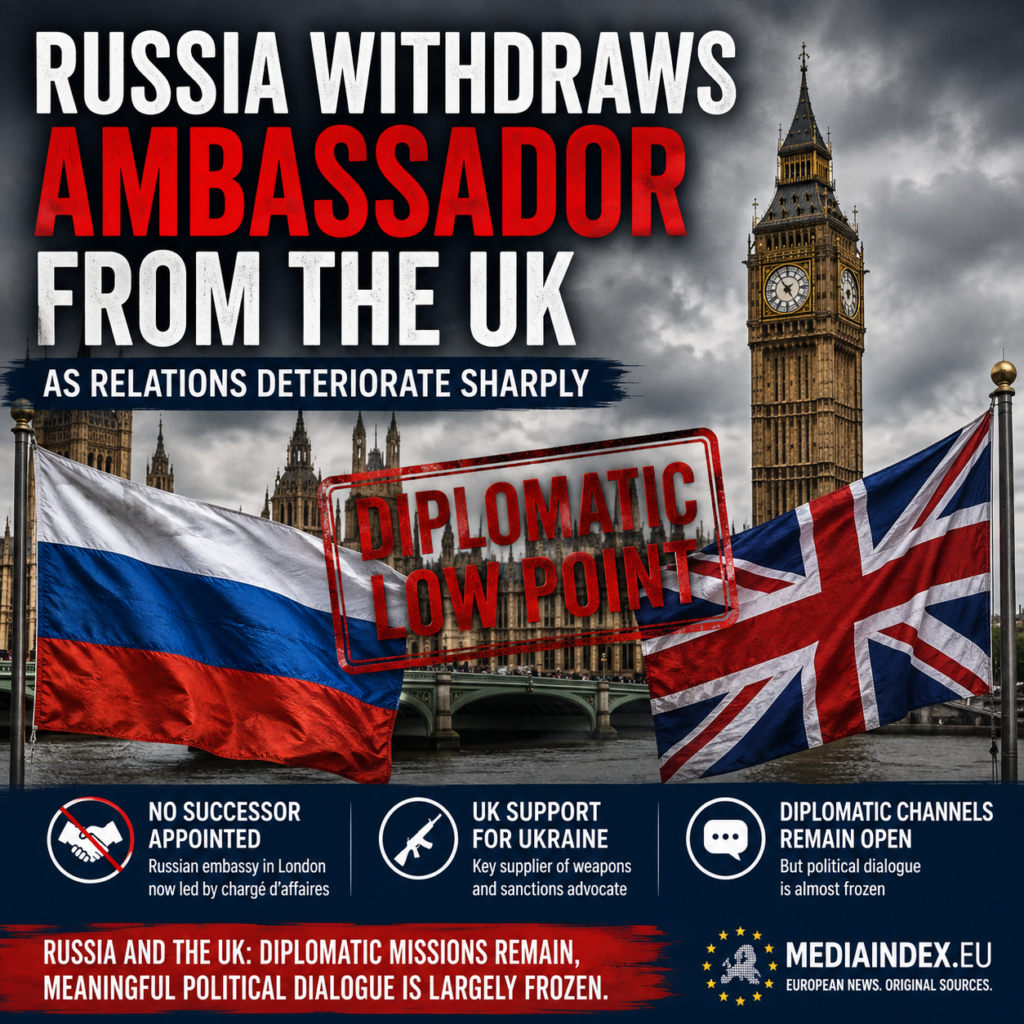
Russia withdraws ambassador from the UK as relations deteriorate sharply
Russia has withdrawn its ambassador to the United Kingdom, Andrey Kelin, after seven years in London. No successor has yet been appointed, and the Russian embassy is temporarily being led by chargé d’affaires Vasily Tsyganov.Kelin’s departure comes at a time when relations between Moscow and London are at one of their lowest points in decades.The central source of tension is Britain’s extensive support for Ukraine. The UK remains one of Kyiv’s key European military backers and continues to push for stronger sanctions against Russia.Tensions have intensified further amid Russian accusations that British technology and weapons are being used by Ukraine in strikes against Russian territory. Moscow has repeatedly warned London of possible “consequences.”Russia has not formally announced a break or downgrade in diplomatic relations, and the UK Foreign Office says diplomatic channels remain open.But the fact that no replacement ambassador has yet been named is another sign of how far relations between the two countries have deteriorated.Russia and the United Kingdom still maintain diplomatic missions — but meaningful political dialogue between them is now largely frozen.
Eni targets commercial fusion power plant in Europe by the early 2040s
Italian energy giant Eni says it wants to help build a commercial nuclear fusion power plant in Europe by the early 2040s — or even sooner.The company is working with US-based Commonwealth Fusion Systems (CFS), one of the world’s best-funded private fusion energy developers. CFS is already preparing to build its first commercial plant in Virginia, while its demonstration reactor in Massachusetts is reported to be more than 75% complete.For Eni, this is not being presented as a side experiment. The company says fusion could eventually become its “next refining business” — in other words, one of its core activities in the post-oil and gas era.Nuclear fusion uses the same physical principle that powers the Sun: light atomic nuclei are fused together at extremely high temperatures, releasing huge amounts of energy.Unlike conventional nuclear power, fusion does not rely on a fission chain reaction and does not carry the same classic meltdown risk. It also produces far less long-lived radioactive waste. But the central challenge remains: no one has yet turned controlled fusion into a stable and commercially viable source of electricity.If Eni and CFS succeed, Europe could see commercial fusion power within roughly 15 years.That would represent a major shift for the continent’s energy system: vast amounts of low-carbon electricity without dependence on gas, oil, solar or wind in the usual way.
UK: Iran-linked hackers shut down a power plant for four days
A cyberattack on a British energy facility forced a small power plant offline for four days. The UK government confirmed the incident and stressed that there was no threat to the national electricity system.According to British media reports, the attack may have been carried out by hackers linked to Iran. There is currently no public confirmation from the UK government that Tehran or Iranian state institutions directly ordered the operation.The incident took place last month and has gained particular significance amid rising tensions between the United Kingdom and Iran.London has allowed the United States to use British bases for what it describes as defensive operations related to Iran, while insisting that the UK is not participating in US offensive strikes. Iran’s Islamic Revolutionary Guard Corps has previously warned that bases used for operations against Iran could be considered legitimate targets.The UK’s National Cyber Security Centre has already warned that Iran-linked cyber groups have the capability to target infrastructure, while energy systems are becoming increasingly attractive targets for state-backed and state-linked hackers.For now, this was a small energy facility rather than a nationwide blackout. But the fact that a cyberattack was able to physically stop electricity production for four days shows how quickly digital conflict can move from computer networks into real-world infrastructure.