Search results
Russia is turning its “Russian World” propaganda into video games — but Russian players are barely interested
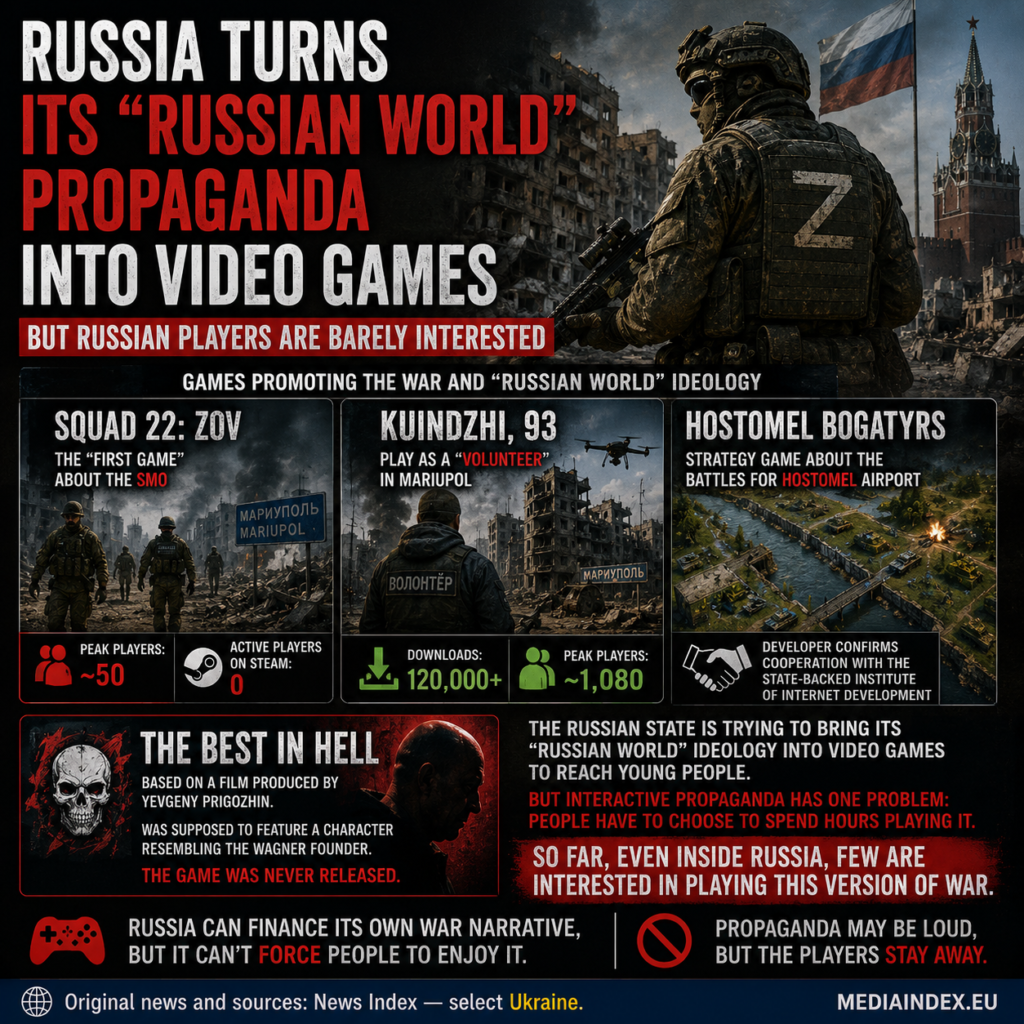
Russian authorities are increasingly trying to bring the ideology of the so-called “Russian World” into video games, using interactive entertainment to promote the Kremlin’s version of the war against Ukraine to younger audiences.Developers are producing games set in Mariupol, Hostomel, Irpin and other places directly connected to Russia’s invasion. Some of these projects receive state funding or are created in cooperation with organisations linked to the Russian government.One of the main sources of financing is Russia’s Internet Development Institute. State support for gaming has already reached levels comparable with film production. Between 2022 and 2024, for example, the historical game “Smuta” received around half a billion rubles, the largest state grant ever awarded to a Russian video game project.A particularly revealing example is “Squad 22: ZOV”, promoted by Russian state media as the “first game about the Special Military Operation.” Its storyline includes Mariupol, the Ukrainian counteroffensive and Avdiivka, while Russian soldiers who took part in the invasion were involved as consultants.One consultant even said the game could be used in the training of members of Yunarmiya, Russia’s state-backed military-patriotic youth organisation.But the audience response was almost nonexistent.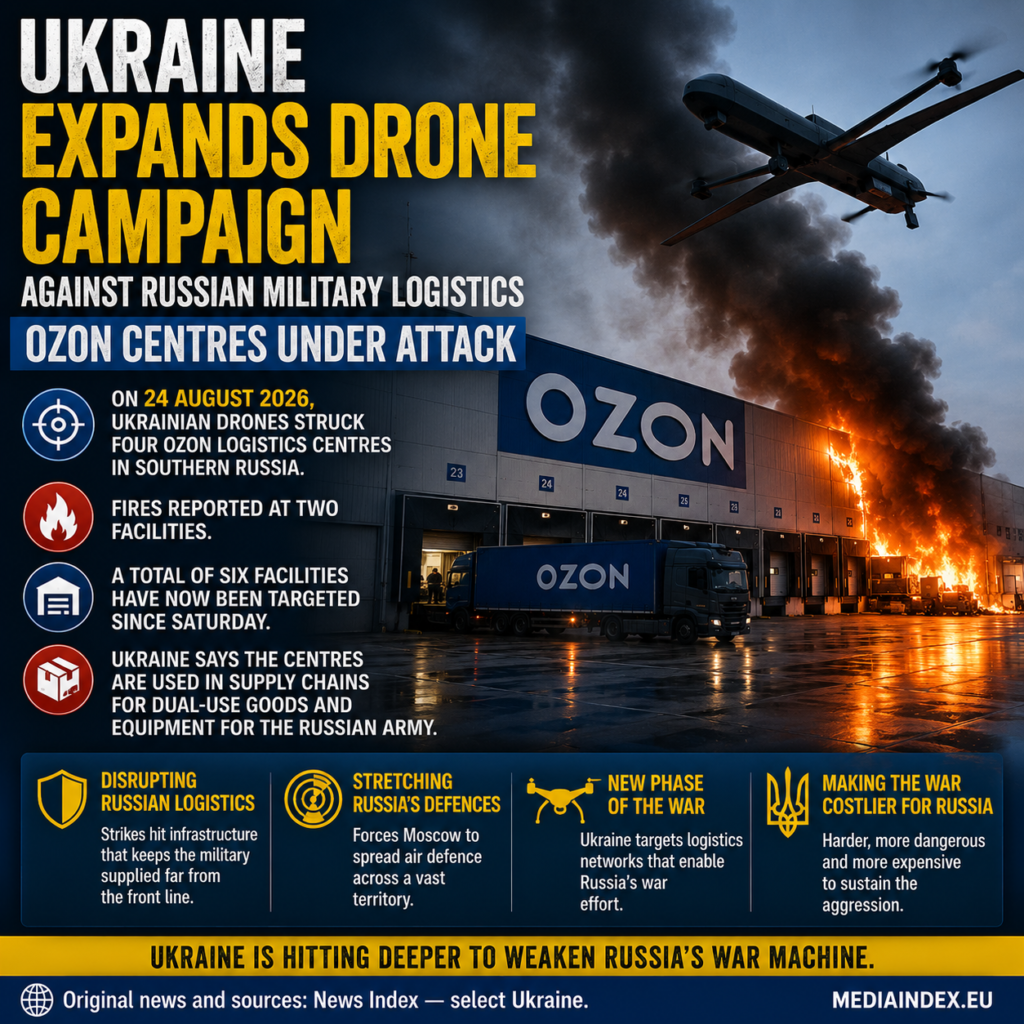
Ukraine expands drone campaign against Russian military logistics as Ozon centres come under attack
On 24 August 2026, Ukrainian drones struck four Ozon logistics centres in southern Russia, expanding Kyiv’s campaign against infrastructure it says is being used to support the Russian military. Fires were reported at two of the facilities.Together with earlier attacks since Saturday, a total of six facilities connected to the Russian e-commerce giant Ozon have now reportedly been targeted.Ukraine says parts of Ozon’s logistics infrastructure are being used not only for civilian e-commerce, but also in supply chains transporting dual-use goods and equipment required by Russian forces.If confirmed, the attacks point to an important development in Ukrainian strategy. Kyiv is increasingly targeting not only oil depots, military airfields and defence factories, but also the broader logistics infrastructure that helps keep Russia’s war machine supplied.For Ukraine, this creates another way to disrupt Russian military supply chains far from the front line. It also forces Russia to spread its air-defence resources across a much larger territory and protect warehouses, transport hubs and industrial facilities hundreds of kilometres from the battlefield.Ozon remains a major civilian company, so confirmation of the military role of the specific facilities being targeted remains important. Ukraine says its objective is infrastructure connected to the supply of Russian armed forces rather than civilian commerce itself.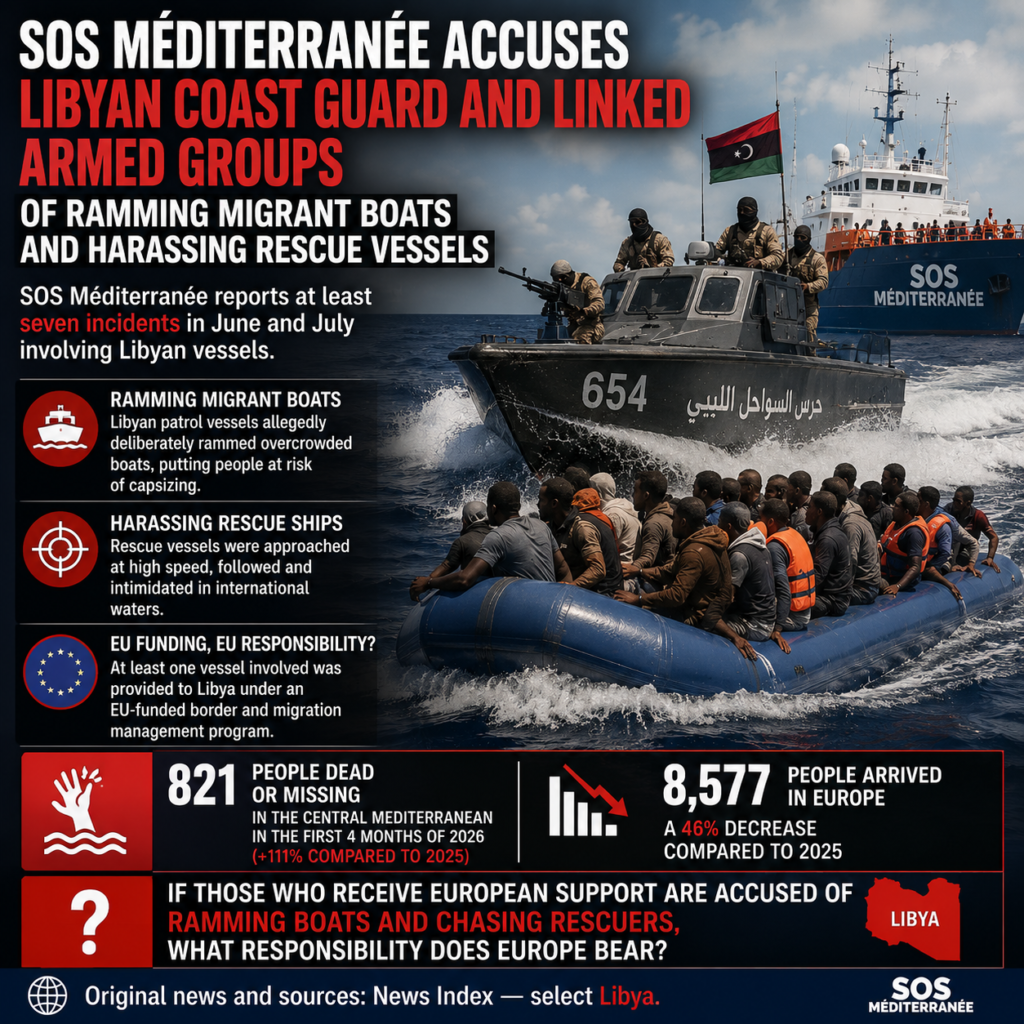
SOS Méditerranée accuses Libyan coast guard and linked armed groups of ramming migrant boats and harassing rescue vessels
Humanitarian organisation SOS Méditerranée says Libyan patrol vessels and armed groups operating off the Libyan coast deliberately rammed migrant boats and harassed European rescue ships in international waters.According to the organisation, at least seven such incidents were recorded in June and July. Libyan vessels allegedly approached rescue ships at high speed, followed them and, in some cases, continued the pursuit for several hours.The most serious allegations concern the migrant boats themselves. SOS Méditerranée says that during several interceptions, Libyan vessels used aggressive tactics and deliberately struck overcrowded boats, creating a serious risk of capsizing.In one documented incident, a patrol vessel reportedly chased an inflatable boat for around 40 minutes and hit it several times. Children and infants were among those on board.The controversy is particularly sensitive for Europe because at least one vessel involved in such operations had been transferred to Libyan authorities under an EU-funded border and migration management programme.This is not the first serious incident. A year ago, the rescue ship Ocean Viking, carrying 87 rescued migrants, came under fire in international waters. SOS Méditerranée said more than 100 shots were fired and the vessel suffered significant damage.Meanwhile, the central Mediterranean route is becoming increasingly deadly.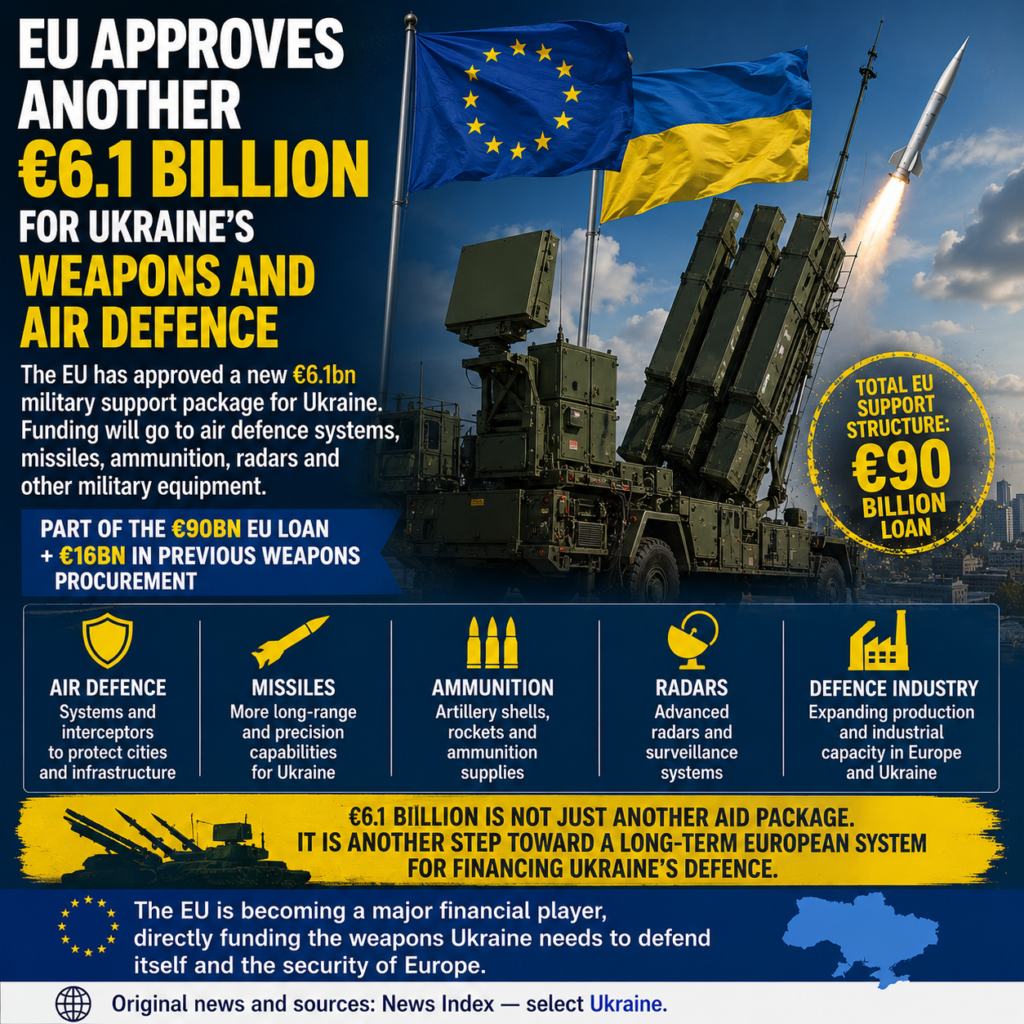
The EU approves another €6.1 billion for Ukraine’s weapons and air defence
The European Union has approved a new €6.1 billion military support package for Ukraine, with funding expected to go primarily toward air defence systems, missiles, ammunition, radars and other military equipment.This is no longer simply another emergency aid package. It forms part of a much larger EU financial structure, including the €90 billion European loan for Ukraine, and comes on top of around €16 billion in previously agreed weapons procurement.The EU is increasingly moving from individual deliveries toward systematic long-term financing of Ukraine’s defence.The support is no longer focused only on transferring weapons from the existing stockpiles of European countries. European funding is increasingly being directed toward procurement, ammunition production, missile production, air defence systems and the expansion of industrial capacity needed for a prolonged war.Air defence remains one of the main priorities. After repeated Russian strikes on Ukrainian cities and energy infrastructure, Kyiv continues to call for more interceptors, radars and modern systems capable of countering cruise and ballistic missiles.For Europe, this marks a significant change in its own role.A few years ago, military support for Ukraine was largely based on decisions taken by individual governments. The EU is now gradually becoming a major financial actor in its own right, directly involved in financing weapons production and procurement.And the sums continue to grow.
The UK is moving closer to the EU again: was Brexit a strategic mistake?
New UK Prime Minister Andy Burnham has told European Council President António Costa that Britain needs to be “bolder” in rebuilding closer ties with the European Union.The discussion is no longer limited to defence and security. Downing Street says the UK wants deeper cooperation across the full range of relations with the EU, with the next UK–EU summit expected to become an important step in that process.And this makes one question increasingly difficult to avoid: was Brexit ultimately a strategic mistake?Britain left the EU in pursuit of greater control over its own laws, borders and trade policy. For supporters of Brexit, restoring national sovereignty remains the central argument in favour of the 2016 decision.But in practice, British policy is gradually moving in the opposite direction.The UK is once again seeking closer ties with the EU in trade, defence, security and other areas. In other words, years after Brexit, Britain is trying to rebuild many of the connections it deliberately loosened with the largest economic and political bloc on its doorstep.The economic question has never disappeared either.The UK’s independent Office for Budget Responsibility still assumes that post-Brexit trade barriers will leave the British economy’s long-term productivity around 4% lower than it would have been if the UK had remained in the EU.That does not mean Britain is preparing to rejoin the European Union.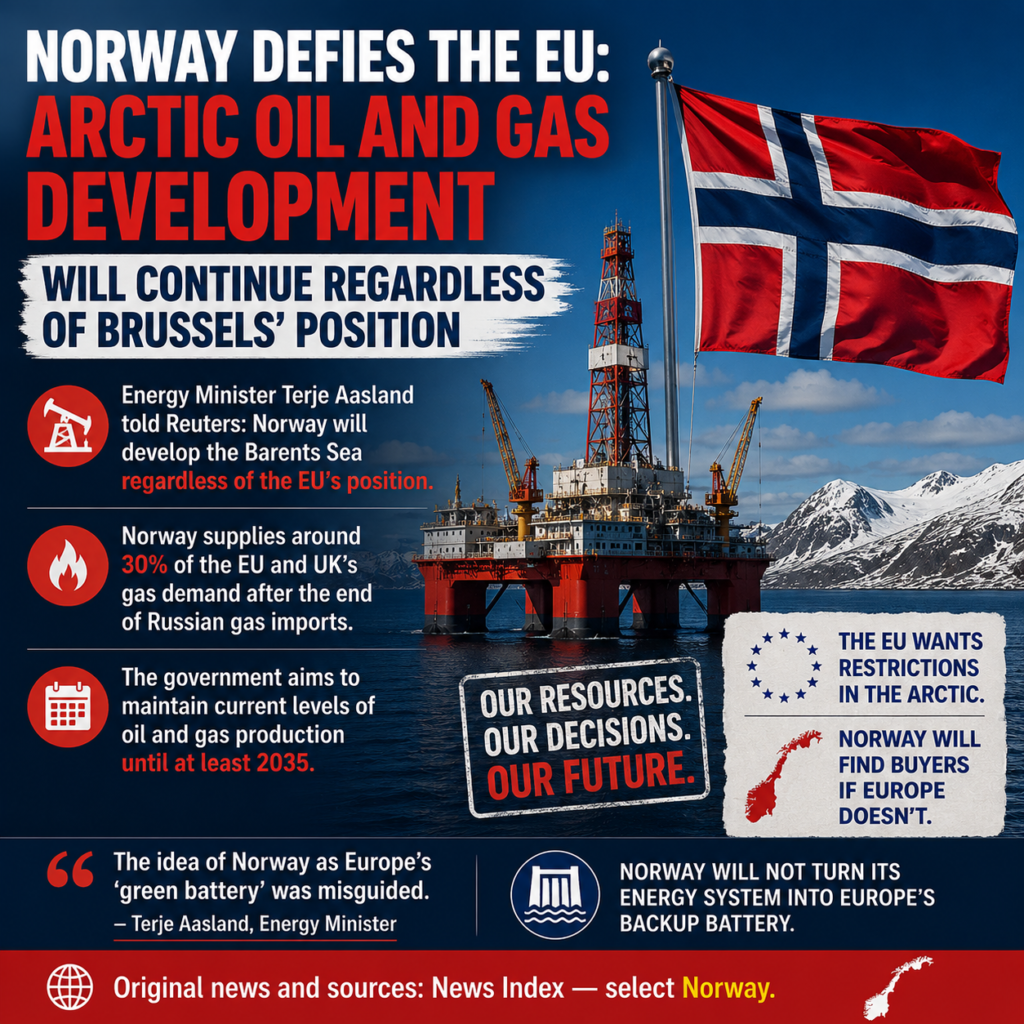
Norway defies the EU: Arctic oil and gas development will continue regardless of Brussels’ position
Norway has made it clear that it has no intention of abandoning the development of oil and gas resources in the Barents Sea, even if the European Union continues to push for restrictions on Arctic fossil fuel extraction.Energy Minister Terje Aasland told Reuters that Norway will continue developing its Arctic resources regardless of the EU’s position. According to him, the country sees activity in the Barents Sea as a matter of national sovereignty and long-term energy security.After the sharp reduction in Russian gas supplies, Norway became Europe’s largest gas supplier. Today, it covers around 30% of gas demand in the EU and the United Kingdom, and Aasland directly links further Arctic development to the need to maintain those supplies.The Norwegian government aims to keep oil and gas production at roughly current levels until at least 2035.Brussels, however, takes a very different position. The EU has been pushing for restrictions on further Arctic fossil fuel development because of climate and environmental concerns.But Norway’s response is effectively simple: if Europe does not want to buy Arctic oil and gas, Norway can look for other customers.The country already has LNG export infrastructure, including the Melkøya plant. That means Brussels may try to reduce the use of Arctic fossil fuels inside Europe, but it cannot prevent Norway from developing its own resources.
Germany turns former power plant into one of Europe’s largest AI data centres in €11 billion project
In Lübbenau, Brandenburg, one of Europe’s largest artificial intelligence infrastructure projects is taking shape.Schwarz Group — the owner of Lidl and Kaufland — is investing around €11 billion to transform the site of a former power plant into a massive AI data centre. The facility is expected to house around 100,000 GPUs, primarily for training and running large AI models.The first server halls are scheduled to begin operating by the end of 2027. The complex will cover around 13 hectares and will serve both Schwarz Group’s own digital operations and external customers, including public-sector institutions.The location is particularly symbolic. Lübbenau is part of Lusatia, a region historically associated with coal mining and power generation. Now a former energy site is being turned into infrastructure for a new economy: from coal to computing power, from electricity generation to artificial intelligence.But the transition comes with an enormous energy cost.At full capacity, the complex is expected to consume roughly as much electricity as a medium-sized city. Schwarz Group says the site will operate using renewable energy, with additional solar generation planned on the property.Another major part of the project is heat recovery. The huge amount of heat produced by the servers could be fed into district heating networks and potentially provide heating for up to 75,000 homes during colder months.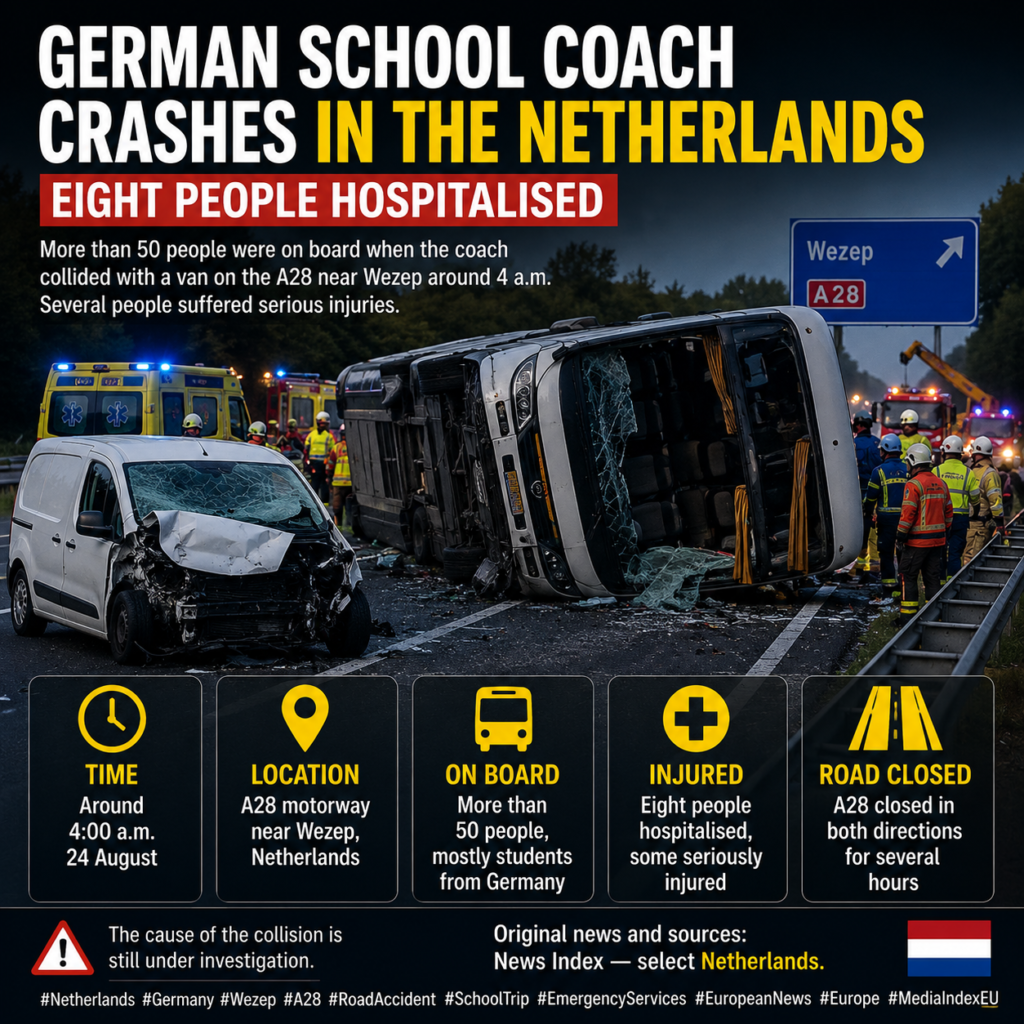
German school coach crashes in the Netherlands: eight people hospitalised
A serious accident involving a coach carrying German schoolchildren occurred early on 24 August on the A28 motorway near Wezep in the eastern Netherlands.More than 50 people were on board the coach, most of them students from a German secondary school. At around 4 a.m., the coach collided with a van, broke through the roadside barrier, crossed the central reservation and ended up on its side near the opposite carriageway.According to police, eight people were taken to hospital, with some suffering serious injuries. Several others sustained minor injuries. The driver of the van was also among those hurt. No deaths have been reported.The collision caused extensive damage. The van was severely damaged, while emergency crews used the coach’s emergency exits, including roof exits, to help passengers get out safely.The A28 was closed in both directions while emergency services worked at the scene, investigators examined the crash and damaged vehicles were removed.The exact cause of the collision is still under investigation.A routine school journey through a neighbouring European country turned into a major rescue operation within seconds. Despite the severity of the crash, there have so far been no reports of fatalities.Original news and sources: News Index — select Netherlands.
Three migrants arrested in Ceuta after attack on off-duty Guardia Civil officer
Three young migrants have been arrested in the Spanish city of Ceuta on suspicion of attempted robbery and assaulting an off-duty Guardia Civil officer. According to Europa Press, all three entered the city during the mass border crossing on 30 July.The incident took place at around 4:30 a.m. on 23 August near a petrol station in the port area. Police say the officer was approached and asked for money. After refusing, he was allegedly attacked with punches and kicks before the suspects fled.The Guardia Civil officer reported the incident to the Policía Nacional. Within minutes, police located the three suspects in separate nearby locations. They were arrested on suspicion of violent robbery or attempted robbery, as well as resisting police.The incident comes amid an extremely tense situation in Ceuta following the unprecedented migration crisis at the end of July. Around 72,000 people attempted to enter the Spanish enclave from Morocco, and several weeks later an estimated 5,000 to 8,000 migrants were still believed to remain in Ceuta.The situation is particularly sensitive because Morocco has once again raised the issue of sovereignty over Ceuta and Melilla, while Spain has categorically rejected any discussion over the status of the two cities.An individual crime should not automatically be used to judge the thousands of people who arrived in Ceuta during the July crisis.