
Search results

Sweden rehearses mass handling of war dead for first time in decades
Sweden has carried out something that only a few years ago would have seemed almost unimaginable to much of its population: the military, government agencies and the Church of Sweden jointly rehearsed the mass handling of the dead in the event of a major war. During the Aurora 26 exercises, hundreds of mannequins and real military body bags filled to realistic weight were used. Participants had to work through the entire chain — recovering the dead from a combat area, confirming death, identifying bodies, registering them, notifying relatives and foreign authorities, transporting remains and organising temporary burial. Sweden had not conducted an operation of this scale since the early 1950s.The darkest part of this story is not the number of mannequins or the unusual nature of the exercise. It is the fact that a developed European country once again considers it necessary to prepare soldiers, civil servants, clergy and medical personnel for the consequences of a large-scale war. Swedish authorities stress that the exercise does not represent a forecast of hundreds of thousands of deaths and that emergency burial capacity is a planning requirement, not an expectation of casualties. Yet the return of such scenarios is inseparable from the deterioration of European security following Russia’s full-scale invasion of Ukraine in February 2022.
Poland investigates possible terror attack at drone factory and foreign intelligence involvement
Poland has opened one of its most serious recent investigations into possible sabotage targeting the country’s defence industry. During the night of 30–31 August 2026, a fire broke out at a WB Electronics facility in Skarżysko-Kamienna, part of one of Poland’s largest privately owned defence groups. Investigators believe the blaze was started deliberately using a device containing combustible materials, while production and storage areas suffered damage estimated at no less than PLN 15 million. Prosecutors are examining the case both as a possible terrorist offence and as potential activity carried out on behalf of a foreign intelligence service. Poland’s Internal Security Agency, the police and the National Prosecutor’s Office are all involved in the investigation.The incident is particularly significant because of the role played by WB Group. The Polish company manufactures FlyEye reconnaissance drones, WARMATE loitering munitions, the GLADIUS reconnaissance-strike system and other technologies used by the Polish Armed Forces and Ukraine. In May 2026, Poland signed major contracts with WB Group for new unmanned systems, among the largest agreements of their kind in Europe. That means the possible foreign-intelligence angle is not being investigated in relation to an ordinary industrial site, but to a company directly involved in expanding Polish military production and supplying systems relevant to Ukraine’s war effort.
Germany prepares to formally blame Russia for attempted attack at Leipzig/Halle Airport
Germany is preparing to take one of its most serious steps yet in the investigations into suspected Russian sabotage operations across Europe. According to people familiar with the federal government’s position, Berlin is expected to formally attribute an attempted attack on a Ukrainian cargo aircraft at Leipzig/Halle Airport in August 2026 to Russia. The incident is no longer being treated simply as an aviation security breach. Investigators found a drone carrying industrial explosives and a detonator close to Ukrainian Antonov transport aircraft, and federal authorities are examining the case as a potentially deliberate act of sabotage. The German government is also coordinating its response with European partners and NATO allies. A formal public accusation had not yet been issued when the latest information emerged, but Berlin appears to be moving toward an official attribution.The possible scale of the operation makes the case far more serious than an ordinary drone incident near an airport. Leipzig/Halle is one of Germany’s most important air-freight hubs and also plays a role in logistics connected to NATO and military support for Ukraine. Heavy Antonov An-124 transport aircraft are regularly present there and are capable of carrying unusually large military and civilian cargoes. Investigators believe the drone discovered in early August may have been intended to attack one of those aircraft.
Giorgia Meloni approaches historic record for political stability in post-war Italy
Giorgia Meloni’s government is approaching a milestone that carries almost symbolic importance in modern Italian politics. The cabinet, sworn in on 22 October 2022, is set to surpass the 1,412 days served by Silvio Berlusconi’s second government and become the longest-lasting government of the Italian Republic since the Second World War. For a country where governments have repeatedly collapsed because of coalition disputes, party splits and parliamentary crises, almost four uninterrupted years under the same prime minister represents a remarkable political achievement. Since 1946, Italy has had dozens of governments and more than thirty prime ministers, while the average cabinet has historically survived for little more than a year. Meloni’s ability to keep the current coalition together therefore stands out sharply against the entire post-war record.Yet the historic stability record is arriving at precisely the moment when Meloni faces a new and unexpected political problem. Her Brothers of Italy party remains comfortably ahead in national polling, but a new political force is growing rapidly to the right of the governing coalition. Former general Roberto Vannacci, who broke with Matteo Salvini’s League and created Futuro Nazionale, is already polling at around 7–8% in some surveys and has begun overtaking both the League and, in some cases, Forza Italia. The central political question in Italy is therefore changing.
Germany plans production of up to 1,000 long-range missiles annually near Leipzig
Germany could soon acquire an entirely new component of its defence industry as the American company Covenant prepares to establish production near Leipzig for missiles with a reported range of more than 1,500 kilometres. According to sources familiar with the project, German manufacturing could begin in 2027, with potential annual capacity eventually reaching as many as 1,000 missiles. For Europe’s defence industry, that would be an exceptionally large figure, particularly for long-range precision-strike weapons that are usually produced in much smaller numbers and can cost millions of dollars per unit. The plan would also go beyond simply assembling an American weapon in Germany, because most components are expected to come from German and other European suppliers, gradually creating a largely regional supply chain around the programme.The project does not mean that the German government has already decided to buy 1,000 missiles or signed a final contract with Covenant. The company and Germany’s Defence Ministry have not publicly disclosed the status of negotiations, and the exact missile that would be produced near Leipzig has not yet been officially confirmed. However, the plans are emerging at precisely the moment when Berlin is trying to close one of the Bundeswehr’s most significant capability gaps: the lack of a large-scale arsenal for precision strikes at distances well beyond 1,000 kilometres. That gives the project importance far beyond one possible factory.
NATO headquarters espionage scandal raises serious questions over Canada’s security screening
A highly sensitive espionage investigation is developing in Mons, Belgium, involving a Canadian citizen of Chinese origin who had been working as an intern at the Supreme Headquarters Allied Powers Europe, better known as SHAPE. Belgian prosecutors suspect the woman of espionage on behalf of a foreign state and participation in a criminal organisation. Authorities have not officially identified the country she was allegedly working for, although sources familiar with the investigation have pointed to China. The accusations have not yet been tested in court and the suspect is entitled to the presumption of innocence. Even so, the case has already moved beyond an ordinary criminal investigation because it concerns a person who succeeded in obtaining a position inside one of NATO’s most important military command structures.The central question is no longer simply whether classified information was collected or transmitted. Investigators and politicians are increasingly asking how someone who later attracted such serious counterintelligence concerns passed the necessary checks and gained access to an IT-related role inside SHAPE. Mons is home to Allied Command Operations, the structure responsible for planning and conducting NATO military operations. The complex also contains units connected with communications, cybersecurity and military command systems.
Several theories emerge over CIA chief’s secret Moscow mission after unusual visit
Several days after CIA Director John Ratcliffe’s unexpected visit to Moscow on 25 August 2026, the mystery surrounding the trip has not diminished. The White House has still not published an official agenda, the CIA has not disclosed the substance of the meetings, and the Kremlin has confirmed only that the American intelligence chief held talks with Russian counterparts and that Vladimir Putin was later briefed on the results. Ratcliffe did not meet Putin personally. Donald Trump described the journey as “semi-routine”, yet the format looked anything but routine: the CIA director flew personally to Moscow aboard a US military C-17 that had previously stopped in Riga, spent several hours in the Russian capital and left the country the same day.In the days since the visit, several explanations have emerged in American and European media: a warning to Russia against testing NATO militarily, discussions about Ukraine and long-range strikes, US concerns over Moscow’s relationship with Iran, possible closed humanitarian or prisoner-exchange issues, and a much harsher theory connected with the death of Senator Lindsey Graham. None of these has been officially declared by Washington as the full reason for the trip. Even the NATO-related explanation, which has received the most detailed reporting, is based on sources familiar with the mission rather than a public statement from the administration.
Ferry capsizes off Cyprus, leaving eight dead and eighteen still missing
A major maritime disaster unfolded on 30 August 2026 off the northern coast of Cyprus, where the passenger ferry FILOJET capsized shortly after leaving Kyrenia on its way to the Turkish port of Taşucu. There were 259 passengers and eight crew members on board, making a total of 267 people. Initial reports spoke of seven fatalities and 23 people missing, but the figures were later updated: eight deaths have now been confirmed, 241 people have been rescued, and searches are continuing for another 18. The rescue operation has been running continuously since the accident, involving ships, helicopters, drones and other resources deployed by Turkey and Turkish Cypriot emergency services.The disaster occurred very soon after the ferry began its journey. FILOJET departed Kyrenia around midday and headed toward Taşucu in Turkey’s Mersin province. A short time later, the vessel reportedly began taking on water rapidly, lost stability and capsized. Early reports placed the initial capsizing roughly two kilometres from the coast, although later statements from transport officials suggested that the first problems may have started farther offshore. After overturning, the ferry eventually sank completely and is now believed to be lying at a depth of around 514 metres. The reason for such rapid water ingress has not yet been established, and investigators are still trying to determine exactly how the situation deteriorated so quickly.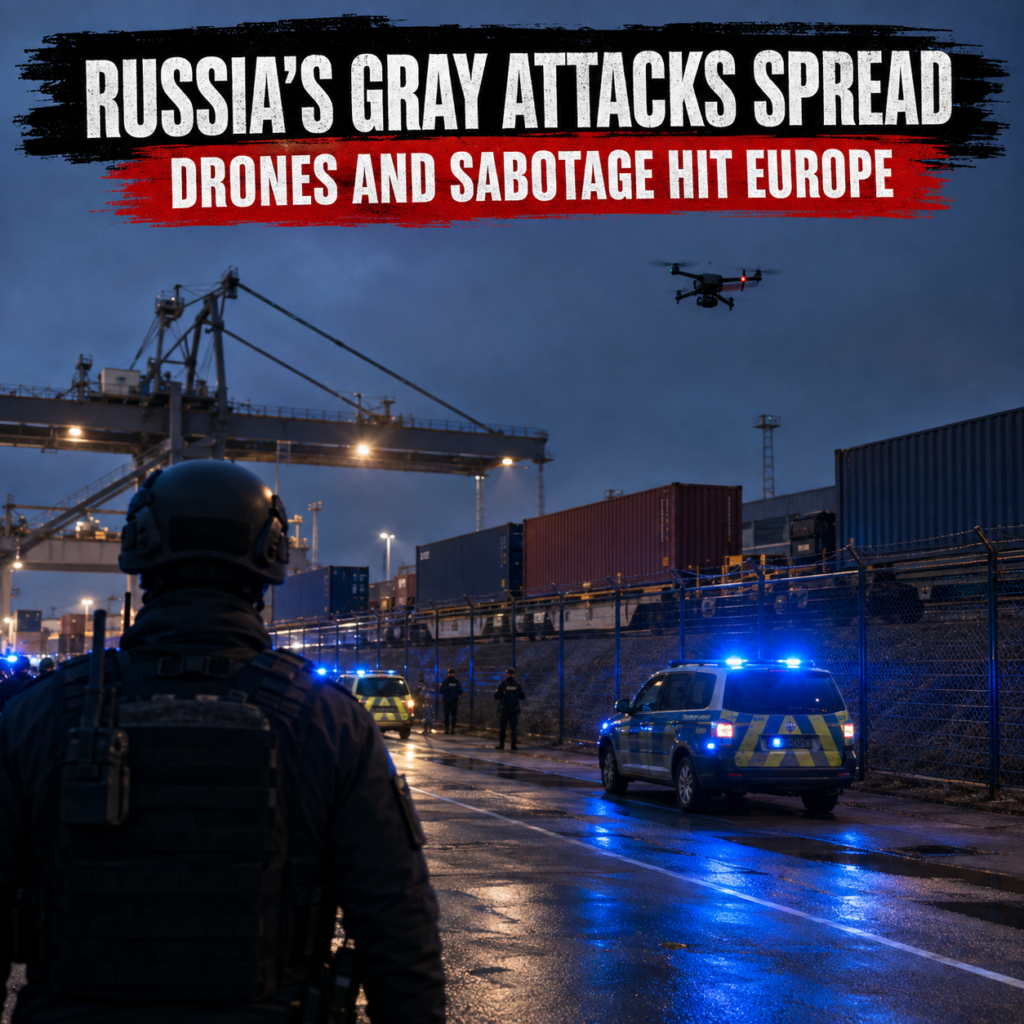
Europe faces a new wave of Russian gray-zone attacks below the threshold of war
Across Europe, a clearer pattern is emerging that increasingly looks less like a collection of isolated sabotage cases, cyber incidents or suspicious drone flights and more like a single form of pressure deliberately kept below the threshold of open military attack. A report published on 30 August 2026 brought together cases in Germany, Romania, Estonia, Italy, Bulgaria, Finland and other countries as part of a broader wave of so-called gray-zone operations. European and NATO officials increasingly describe a mix of drone incursions, sabotage, cyberattacks, electronic interference, surveillance of sensitive facilities and the recruitment of local operatives through social media to carry out individual tasks for relatively small amounts of money.The defining feature of this model is deniability and ambiguity. Russia is not sending regular military formations across NATO borders, and the Alliance does not currently assess a major conventional attack on its territory as imminent. Instead, European security services are dealing with incidents that can each be explained separately as technical failures, ordinary crimes, actions by individuals or accidents. Yet NATO and the European Union already publicly describe an ongoing Russian hybrid campaign involving sabotage, cyber operations, attacks on critical infrastructure, electronic interference, disinformation and the use of intermediaries. It is the accumulation of these incidents that is gradually changing Europe’s understanding of security.