
Search results
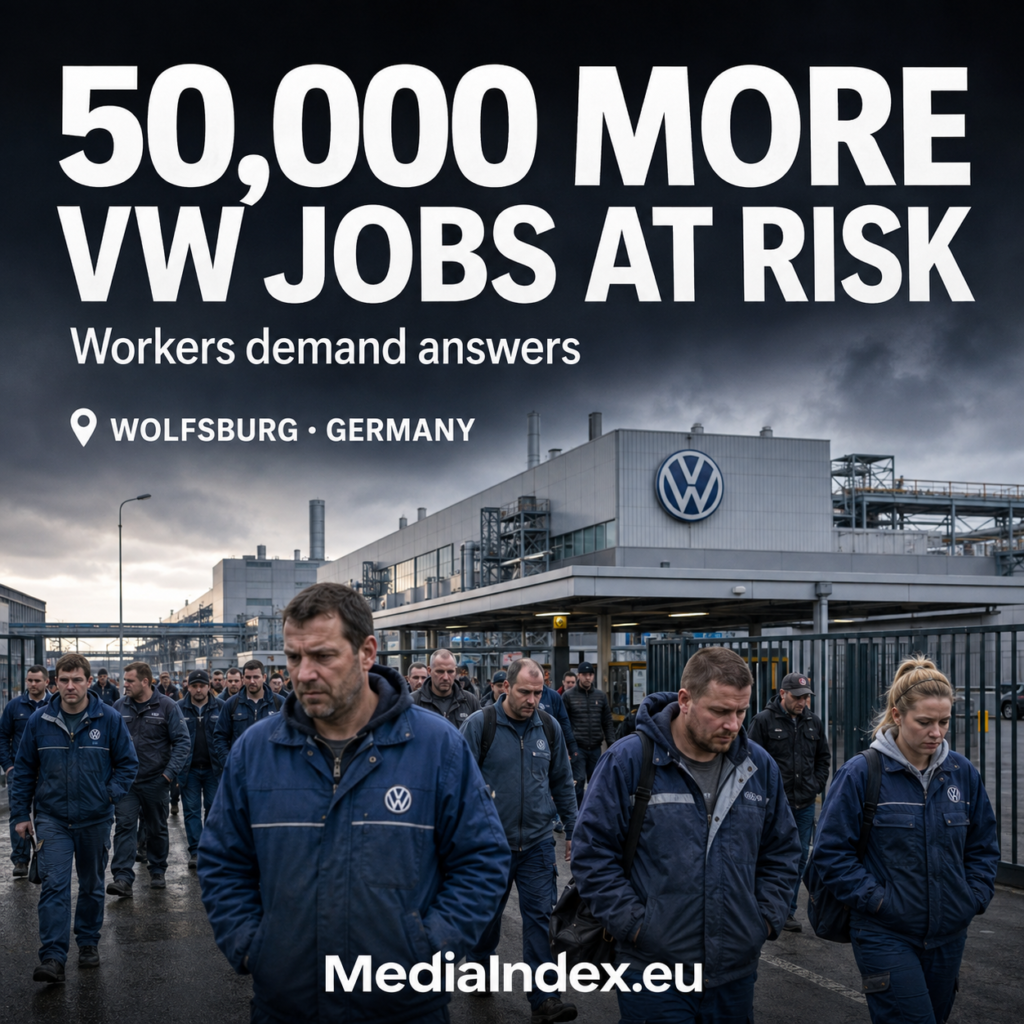
Volkswagen warns that another 50,000 jobs could be cut
The crisis facing Europe’s largest carmaker is becoming increasingly serious. Volkswagen has already agreed to eliminate around 50,000 jobs across its brands, including Volkswagen, Audi and Porsche. Management now acknowledges that as many as 50,000 additional positions could be affected.Employees have accused the company’s board of “disastrous communication.” In an internal survey, the lack of transparent information emerged as workers’ biggest complaint — ranking even above fears about job losses and potential factory closures.According to the works council, employees and their families have been left uncertain and frightened. Particular concern surrounds four German facilities: Volkswagen plants in Emden and Zwickau, the Volkswagen Commercial Vehicles factory in Hanover, and Audi’s plant in Neckarsulm.Chief Executive Oliver Blume has acknowledged that the company’s situation is “more than critical.” He said Volkswagen is not earning enough to finance new technologies and products or secure the long-term future of its production sites.The group’s first-half operating profit fell by 11.6% to €5.9 billion, while its operating margin declined from 4.2% to 3.8%.Volkswagen is simultaneously confronting weaker demand, US tariffs, high German production costs and intensifying competition from Chinese manufacturers. For comparison, the head of Mercedes-Benz recently said that the company’s operating costs in Germany were approximately 70% higher than at its Hungarian plants.
Saudi Arabia to invest €6 billion in three theme parks near Paris
France and Saudi Arabia have signed a memorandum for the development of a major entertainment complex consisting of three theme parks near Cergy-Pontoise, approximately 30 kilometres northwest of Paris.The announced investment totals €6 billion, or around $7 billion. The project will be financed by Qiddiya Investment Company, a subsidiary of Saudi Arabia’s sovereign wealth fund.According to the Élysée Palace, construction and operation of the complex are expected to create approximately 22,000 jobs — more than the number generated by Disneyland Paris.French President Emmanuel Macron described the agreement as unprecedented and said the new parks should turn the Paris region into another global tourism destination.It would be the largest entertainment development built in France since Disneyland Paris opened in 1992.The main attraction is expected to be a theme park dedicated to the universe of Dragon Ball Z, one of the world’s most recognisable Japanese manga and anime franchises.The complex is planned for the former Mirapolis site in the Val-d’Oise department. Mirapolis opened in 1987 but operated for only a few years before closing permanently in 1991 because of financial problems and low attendance.The abandoned site may now be given a second life on an entirely different scale.According to preliminary information, the Dragon Ball Z park could cover approximately 500,000 square metres.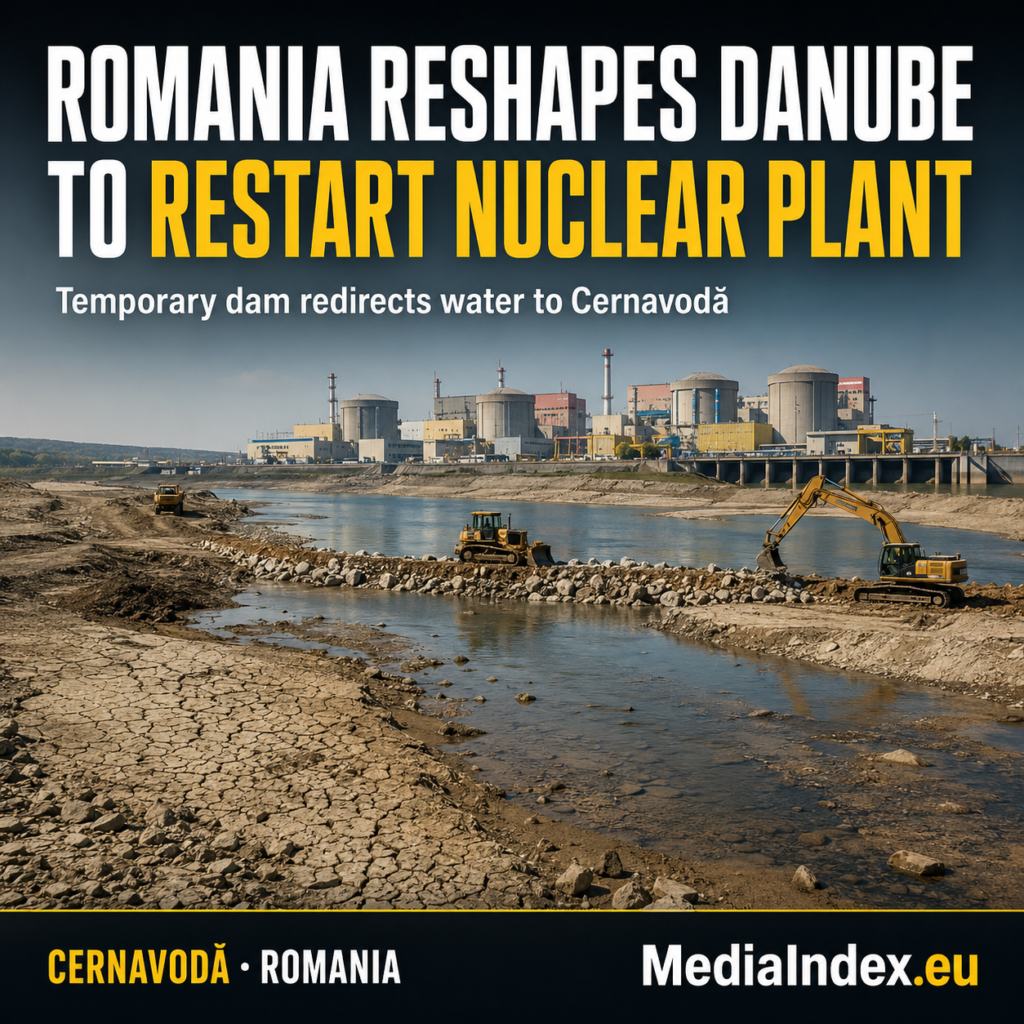
Romania is building a temporary dam on the Danube to restart the country’s only nuclear power plant
Romania has launched a new emergency operation to rescue the Cernavodă Nuclear Power Plant, which was shut down because of historically low water levels in the Danube.The state water management company Apele Române is constructing a transverse guide dam on the Old Danube branch. The structure is intended to alter the distribution of the river’s flow and direct more water towards the channel supplying the nuclear plant’s cooling system.Emergency dredging is also continuing around Cernavodă, coordinated by Apele Române and the Lower Danube River Administration.Romania is effectively attempting to alter the local flow of one of Europe’s largest rivers to restore nuclear electricity generation.Cernavodă is Romania’s only nuclear power plant. It operates two Canadian-designed CANDU reactors, each with a capacity of approximately 700 MW. Under normal conditions, the station generates around 20% of Romania’s electricity.However, prolonged drought, extreme heat and the absence of significant rainfall have pushed the Danube to record-low levels.The problem is not simply the amount of water in the river. The plant requires a constant and sufficient supply of water to cool its reactors safely. When the river drops below the operational threshold, the pumps can no longer be guaranteed access to the necessary flow.Cernavodă’s first reactor was shut down in late July.
Italy prepares to fine pedestrians for using phones while crossing the road
Italy is preparing to extend its crackdown on mobile phone use behind the wheel to another group of road users: pedestrians.An updated draft of the Italian Highway Code introduces fines for people who look at a smartphone screen while crossing the road. The minimum penalty will be €75, although the fine may be higher in certain cases.The new rules have not yet entered into force. They are included in a draft code that the authorities expect to approve by mid-October 2026.The main objective is to reduce situations in which a driver notices a distracted pedestrian too late and is physically unable to stop. Italy’s Ministry of Transport argues that someone who steps into the road while reading a message, watching a video or typing creates a danger not only to themselves but also to other road users.The ban will not apply only to smartphones.While crossing the road, pedestrians will also be prohibited from being distracted by tablets, laptops, digital cameras and other electronic devices if their use prevents them from paying proper attention to traffic.However, the authorities have included several exceptions.Pedestrians will still be allowed to hold conversations through a headset or hands-free system because this does not require them to look at a screen or hold the device in front of their face. Using a phone in an emergency will also remain permitted.Earphones will not be banned completely.
Germany Faces a New Generation of Criminal Clans as Saxony Police Target Four Syrian Family Networks
German law enforcement authorities are warning about the growing activity of criminal family networks of Syrian origin in Saxony, particularly in the Leipzig area. A special inter-agency Taskforce Clan is currently focusing on four large families around which, according to Saxony’s State Criminal Police Office (LKA), stable criminal structures have developed.According to police estimates, approximately 700–1,000 people in Saxony are associated with what authorities describe as the Syrian clan environment. Around 130 of them are known to police in connection with criminal offences. This distinction is important: belonging to a large family or its wider social circle does not in itself mean involvement in criminal activity.However, the range of crimes described by police is serious: violent offences, drug trafficking, money laundering, tax violations, migrant smuggling, document forgery, illegal financial operations and various forms of fraud. Firearms have also been seized during investigations.One of the main challenges for investigators is the structure of these networks itself.According to Rajko Mertins, head of Saxony LKA’s organised crime division, individual members register companies and use them as fronts for illegal activities. In some cases, property, vehicles or bank accounts are registered in the names of relatives or trusted associates, making it difficult to trace money and identify the true owners.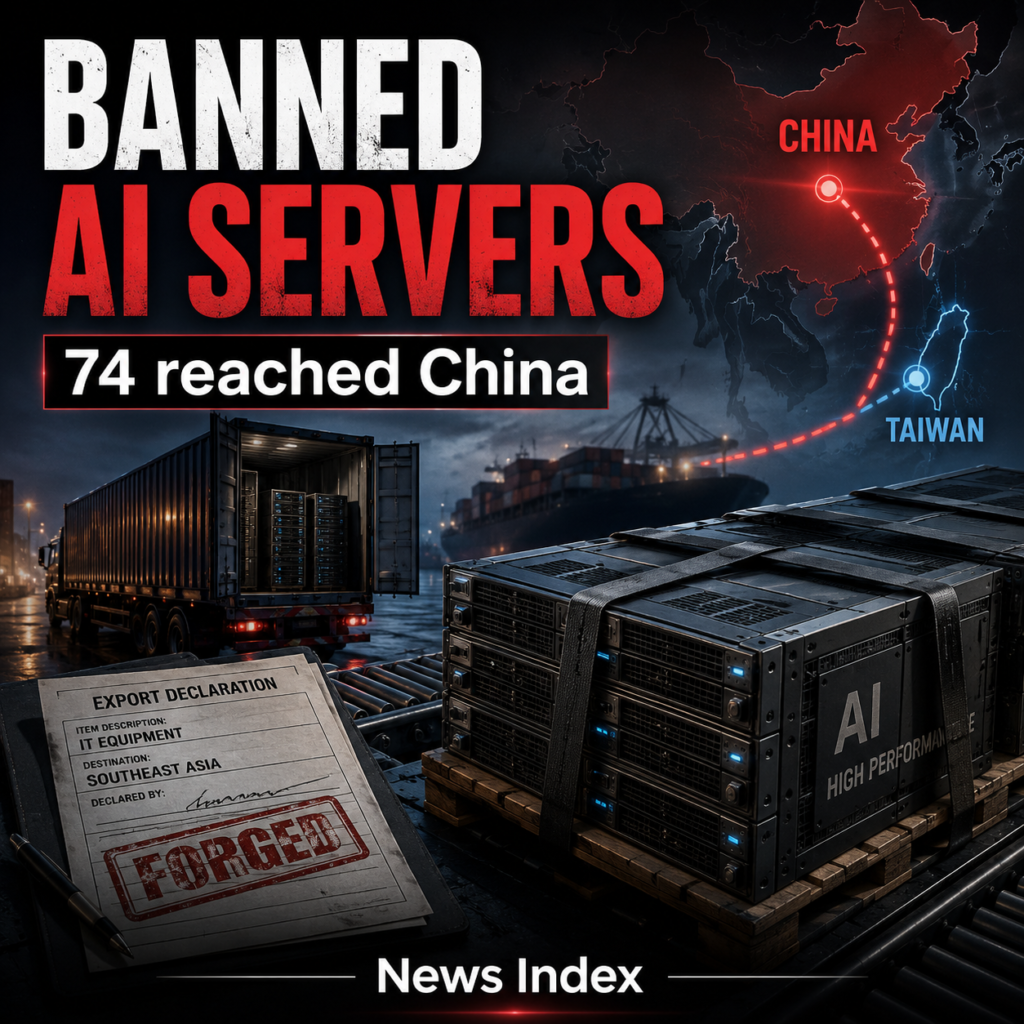
China’s AI race without rules: banned Nvidia servers were secretly routed into China using forged documents and insiders at major tech companies
Taiwanese prosecutors have charged nine people over the alleged illegal shipment of high-performance AI servers equipped with Nvidia chips to China. Among those charged are an employee of Nvidia’s Taiwan operation and two employees of Super Micro.This was not a case of a few processors accidentally appearing on the grey market. According to prosecutors, a full-scale scheme was created to bypass export restrictions and move dozens of servers into China despite controls on access to advanced American AI technology.The case involves 130 Super Micro B300 servers equipped with powerful Nvidia accelerators.Officially, the equipment was supposed to be installed and operated in a data centre in Taiwan. That is what the documentation stated.But prosecutors allege that the real destination was Chinese customers.To bypass controls, the group allegedly used forged documents and routes through third countries and territories, including Japan, Indonesia and Hong Kong.The scheme was effective enough that 74 of the 130 servers reportedly reached China.The remaining 56 were due to be shipped onward through a company in Japan, but Taiwanese customs authorities detected irregularities in the documentation and blocked the shipment.What makes the case particularly significant is that some of the accused allegedly worked inside companies directly involved in producing and supplying the equipment.
Putin opens the way to de facto nationalisation of private business: for investors, Russian assets may become money they can no longer recover
On 24 August 2026, Vladimir Putin signed Decree No. 604, allowing the Russian state to impose temporary management over the property of private companies if authorities decide that their facilities are insufficiently protected, including from drone attacks, or have not been restored quickly enough after damage.Formally, the decree is presented as a measure to protect critical infrastructure. In practice, however, the list of assets covered by it is extremely broad.It includes energy, industry, communications, transport, logistics, utilities, warehouses, potentially hazardous facilities, as well as “other facilities of particular importance to the security, economic stability of the Russian Federation and the functioning of the population.”That final wording radically expands the scope of the decree.In theory, almost any major business that the state considers important to the economy or daily life could fall under these criteria: a factory, retail chain, logistics operator, telecommunications company, transport group, warehouse complex or major industrial enterprise.And the state would not be limited to taking control of one damaged facility.The decree allows temporary managers to take control of all or part of a company’s movable and immovable property, securities, stakes in Russian legal entities and other property rights.
Klaus-Michael Kühne, billionaire behind one of Europe’s largest transport empires, dies aged 89
On 24 August 2026, German billionaire Klaus-Michael Kühne died in Switzerland at the age of 89. He was one of the most influential figures in European logistics and transport, and his death was officially announced by Kuehne+Nagel.Kühne was the grandson of August Kühne, one of the founders of Kuehne+Nagel. He joined the family business in 1958 and became its chief executive in 1966. Over the following decades, the company developed into one of the world’s largest logistics groups.But his influence extended far beyond a single company.Through his investment structures, Kühne held major stakes in Lufthansa, Hapag-Lloyd, Brenntag and transport company Flix. In 2008, he was also part of the investor group that helped keep Hapag-Lloyd under German control rather than allowing the container shipping company to be absorbed by a global rival.His position in Lufthansa became particularly significant. Kühne grew into the airline’s largest private shareholder, controlling around 20% of voting rights. He also held roughly 30% of Hapag-Lloyd.Forbes estimated his fortune at more than $43–44 billion, making him one of Germany’s richest people and one of Europe’s most powerful private investors.His businesses were deeply embedded in the everyday European economy.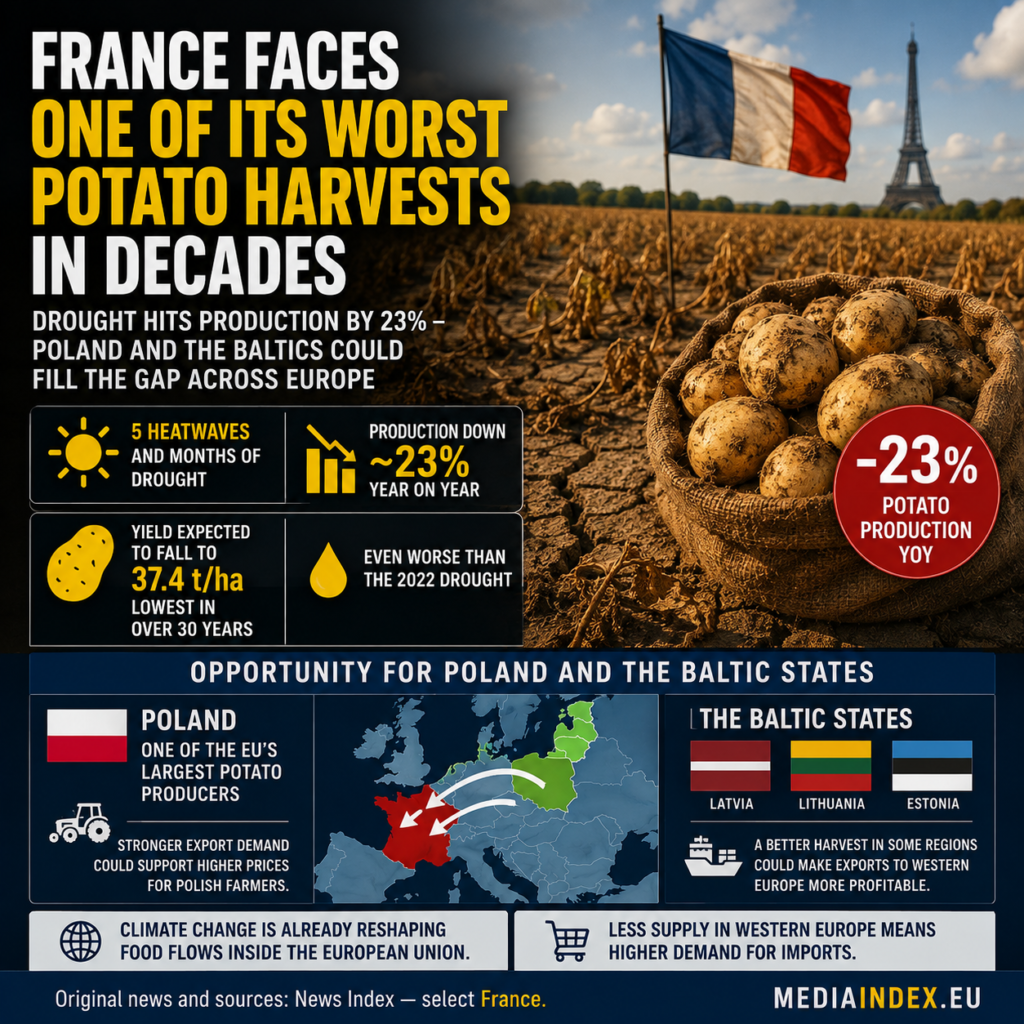
France faces one of its worst potato harvests in decades — and that could open the market to Poland and the Baltic states
After five heatwaves and several months of severe drought, French potato growers are warning of a sharp fall in production. Output could decline by around 23% year on year, while average yields are expected to fall to just 37.4 tonnes per hectare, the lowest level in more than 30 years.France’s problem matters far beyond its own borders. The country is one of Europe’s major potato producers and an important supplier to the processing industry. If French farmers cannot fully meet existing contracts, processors, retailers and industrial buyers will have to look for additional supplies elsewhere in the EU.That creates an opportunity for Central and North-Eastern Europe.Poland remains one of the EU’s largest potato producers. If its harvest holds up well enough, stronger demand from Western Europe could create additional export opportunities and support higher prices for Polish farmers.The Baltic states could also benefit in certain areas. In Latvia, for example, farmers have indicated that this year’s potato harvest could be better than last year’s despite a reduction in planted area. If prices rise in Western Europe, exporting part of that production could become significantly more attractive than selling it domestically at low wholesale prices.However, Poland, Latvia, Lithuania and Estonia cannot automatically replace lost French production.