
Search results

Germany Builds Coalition of EU Donor States Against Nearly €2 Trillion Budget
On August 27, German Chancellor Friedrich Merz is hosting the leaders of the Netherlands, Denmark, Austria, Finland and Sweden in Berlin for a separate discussion on the European Union’s next long-term budget for 2028–2034. The meeting effectively brings together a group of countries that rank among the major net contributors to the EU budget and consider the European Commission’s proposed spending level too high. Germany is trying to build a coordinated position before negotiations between all 27 member states enter their most difficult phase.The European Commission has proposed a seven-year financial framework worth roughly €1.9–2 trillion. Berlin argues that the overall amount should be reduced by several hundred billion euros while a larger share of the remaining money should be redirected toward defense, industrial competitiveness and strategic technologies. The German position is therefore not simply about spending less. Merz is pushing for a different structure of European expenditure, with fewer resources tied to traditional programmes and more directed toward areas that Germany considers essential for Europe’s security and economic position.The August 27 meeting is important because the budget dispute is beginning to turn from a technical negotiation into the formation of political blocs inside the European Union.
Pentagon Prepares Four Options for a New U.S. Military Posture Across Europe
The Pentagon is preparing at least four options for a new deployment of American forces across Europe, with the proposals expected to reach U.S. Defense Secretary Pete Hegseth by November 6. Around 80,000 U.S. military personnel are currently stationed across the continent, making any significant change to their positioning a potentially major development for NATO and the wider European security system. No final decision on troop reductions has been announced, but the review is examining how the American military presence should be structured in the coming years.The process goes far beyond deciding whether several thousand troops should remain in one country or move to another. European NATO allies have been asked detailed questions about military bases, transit arrangements, overflight rights, defense spending, weapons procurement and support for U.S. operations. Washington is therefore examining not only the size of the American presence but also which European countries provide the most useful infrastructure and how much responsibility European governments are prepared to assume for their own conventional defense.For Europe, the review could become one of the most important NATO developments of 2026. American forces on the continent are connected to aviation, intelligence, logistics, command structures, missile defense, nuclear deterrence and the rapid movement of reinforcements. Even if the total number of U.S.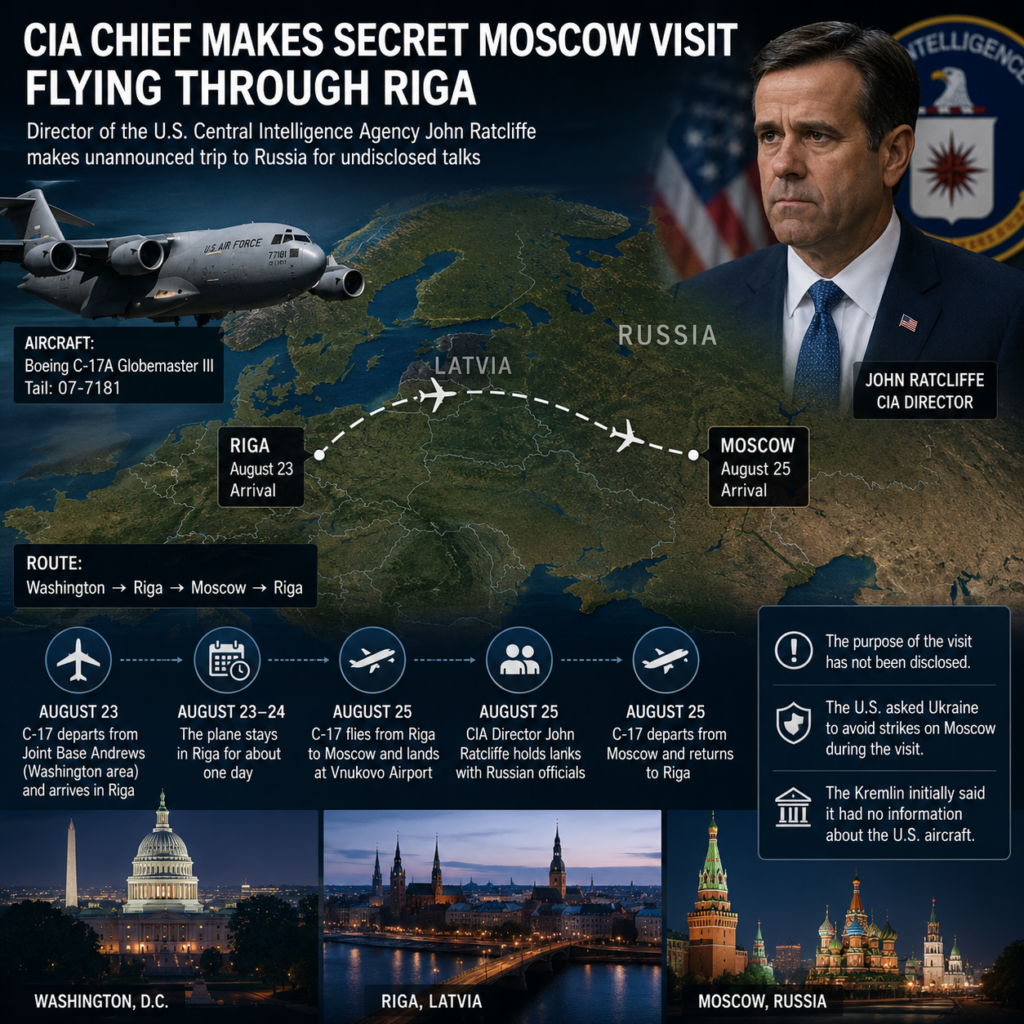
CIA chief makes an unannounced visit to Moscow — with Riga emerging as a key point on the route
CIA Director John Ratcliffe made an unannounced visit to Moscow on August 25 for talks with Russian officials. Neither Washington nor Moscow announced the trip in advance, and the substance of the meetings has still not been officially disclosed.But the route taken by the American delegation is particularly striking.A US military Boeing C-17A Globemaster III, tail number 07-7181, departed from the Washington area and arrived in Riga on August 23. After spending roughly a day in Latvia, the C-17 flew directly from Riga to Moscow on the morning of August 25 and landed at Vnukovo Airport.At around the same time, another US government aircraft — a C-40B, a modified Boeing 737 used to transport senior American officials — also arrived in Riga from Joint Base Andrews.The presence of both aircraft immediately raised questions about whether Riga was being used as a staging point for a sensitive US government mission.Hours later, CBS News, Axios, ABC News and The Washington Post confirmed that CIA Director John Ratcliffe was in Moscow.And that creates the key question for the Baltic region:Why Riga?So far, there is no public answer.The Latvian capital effectively became the intermediate point for one of the most sensitive American missions to Russia in years. The aircraft arrived from the Washington area, remained in Latvia, and then departed from an EU and NATO country directly for Moscow.
Who is behind the planned attack on a drone factory in Slovakia? European intelligence services are already seeing a familiar pattern
Slovak police have prevented a planned arson attack on a drone manufacturing facility in the east of the country. Three foreign nationals have been charged with preparing a particularly serious crime. Two were detained in Slovakia, while the third was arrested in Germany under an urgently issued European arrest warrant.According to police, the suspects were acting on commission. That is one of the most important details in the case: this was not described as a spontaneous protest, personal revenge or an isolated act by individuals, but as an operation ordered against a specific industrial target.Information about the planned attack came from the Slovak Information Service, SIS, and military intelligence.During searches, investigators found a large quantity of incendiary material made from petrol and polystyrene — effectively an improvised napalm-like mixture — as well as tools, mobile phones, an action camera and a hand-drawn plan of the facility.Investigators estimate that around 70 employees could have been inside the plant at the time of the planned attack. The equipment at the facility is believed to be worth tens of millions of euros. Had the operation succeeded, the consequences could have gone far beyond ordinary property damage.Police have not officially identified the company.
European airlines cut Dubai flights — potentially accelerating the decline in property prices
Finnair is suspending all flights between Helsinki and Dubai for the entire 2026–2027 winter season. The route will not operate between 25 October 2026 and 27 March 2027, with the airline citing continuing instability and security risks in the Middle East.This is no longer an isolated decision by a Finnish carrier. A significant number of international airlines are continuing to delay their return to Dubai or reduce their wider Middle East schedules.British Airways is keeping its Dubai services suspended until at least 25 October. Virgin Atlantic has removed its seasonal London–Dubai route for the coming winter, while Air Canada does not plan to resume Dubai flights before mid-January 2027.KLM, Wizz Air, Singapore Airlines and Cathay Pacific have also extended suspensions until approximately the end of October. Other carriers, including Air France and Eurowings, are preparing to return gradually, so it would be premature to describe this as a complete European withdrawal from Dubai.Finnair’s decision is nevertheless particularly significant. The company is not postponing its return by several weeks: it has abandoned the entire winter season, traditionally the most profitable period for European travel to the United Arab Emirates. Airlines are beginning to treat the regional crisis as a long-term factor that must be incorporated into planning for many months ahead.The consequences could extend well beyond aviation.
France to question 10 million pupils about sexual and gender-based violence
French authorities will add questions about sexual and gender-based violence to the annual nationwide questionnaire distributed to school pupils. The survey will cover approximately 10 million children and teenagers, from the final year of pre-school to the end of secondary education.The questionnaire is expected to be distributed in autumn 2026, most likely in November. Previously focused primarily on bullying and the general school environment, it will now directly ask pupils about possible sexual abuse, unwanted touching, threats and other violations of their personal boundaries.The responses will initially remain anonymous. However, pupils will be able to provide their name if they need help or wish to speak to a trusted adult. This is intended to turn the survey into more than a statistical exercise: it could also become a channel for identifying individual children who are currently at risk.French Education Minister Édouard Geffray warned that the results could be “seismic.” According to him, approximately one in ten children in France experiences sexual violence. Many cases are never reported to the police, social services or school authorities.Questioning very young children will be particularly challenging because they may not know legal terminology or understand that what happened to them constitutes abuse. The questions will therefore need to be adapted to each age group and avoid complicated or unnecessarily traumatic language.
Sweden moves to seize Kremlin-linked Russian property beside secret naval base
The Swedish Armed Forces have formally asked the government to expropriate privately owned property located beside the strategically important Muskö naval base, south of Stockholm.The waterfront property belongs to Russian businessman Stanislav Aleshchenko, whom Swedish media have linked to Vladimir Putin’s circle. He acquired the site on Muskö Island in 2017. The property reportedly offers a direct view of the entrance to the military base and vessels moving through the surrounding waters.Muskö is one of Europe’s most unusual military facilities. Much of the complex is built inside a granite mountain, containing underground docks, tunnels, repair facilities, command centres and protected infrastructure capable of accommodating warships. The Swedish Navy returned to the base in 2019 after years of reduced activity.Russian ownership of the nearby property has raised security concerns for years. Previous legislation, however, did not allow the state to seize the site solely because it represented a potential national security risk. The armed forces now argue that control of the land is necessary to protect the base and want it transferred into state ownership.This would not be a seizure without due process. The owner would be entitled to compensation, while the government would have to demonstrate that Sweden’s defence interests outweigh private property rights.
Germany investigates suspected explosive drone attack on strategic Leipzig/Halle Airport
German investigators have discovered a third drone believed to be connected to an attempted attack on Leipzig/Halle Airport. Near the aircraft, they also found around 50 grams of a substance suspected to be the military explosive RDX.The drone was discovered west of the airport on 14 August, ten days after the first serious incident. At another location, investigators found an antenna and electronic components taped to a tree. The equipment may have been used to control a drone remotely. Scorched ground and metal fragments were also found nearby, and investigators are examining whether an explosion occurred there.The first suspicious aircraft was discovered on the airport grounds overnight on 5 August, close to a Ukrainian Antonov Airlines cargo plane. X-ray analysis confirmed that it was a drone equipped with explosives and a detonator. Police deployed a bomb disposal robot before the device was destroyed in a controlled explosion.The incident temporarily halted flights and forced several aircraft to divert. One DHL cargo plane approaching Leipzig/Halle reportedly collided with an unidentified object approximately six kilometres from the airport. It sustained minor damage to its nose but landed safely in Hanover.Leipzig/Halle is not an ordinary regional airport. It plays a key role in transporting military equipment for the German armed forces and NATO allies, while also serving as a European base for Ukraine’s Antonov Airlines.
Britain commits almost £10 billion to affordable rental housing
The British government has announced the first major phase of a ten-year housing programme designed to increase the supply of social and affordable rental homes.The initial funding package will be worth almost £10 billion (€11.6 billion). It forms part of a broader £39 billion programme extending over ten years.More than £7 billion from the first allocation will go to London, where housing shortages and high rents have become one of the country’s most severe social problems. The government expects local councils to deliver more than half of the new homes in the capital.In northern English cities, the first phase is expected to finance approximately 20,000 new homes. Over time, more than £16 billion from the full programme will be allocated to projects outside London.The main priority is social rent housing. Rents in these homes can be around 50% lower than market rates, providing greater security for families on lower incomes.Prime Minister Andy Burnham argues that expanding council housing will help reduce homelessness, lower the government’s long-term welfare bill and make low-income households less dependent on the increasingly expensive private rental market.Burnham said local councils had helped Britain overcome a major housing crisis once before, following the Second World War, and could do so again if given sufficient funding and authority.The programme will also support the government’s devolution agenda.