
Search results
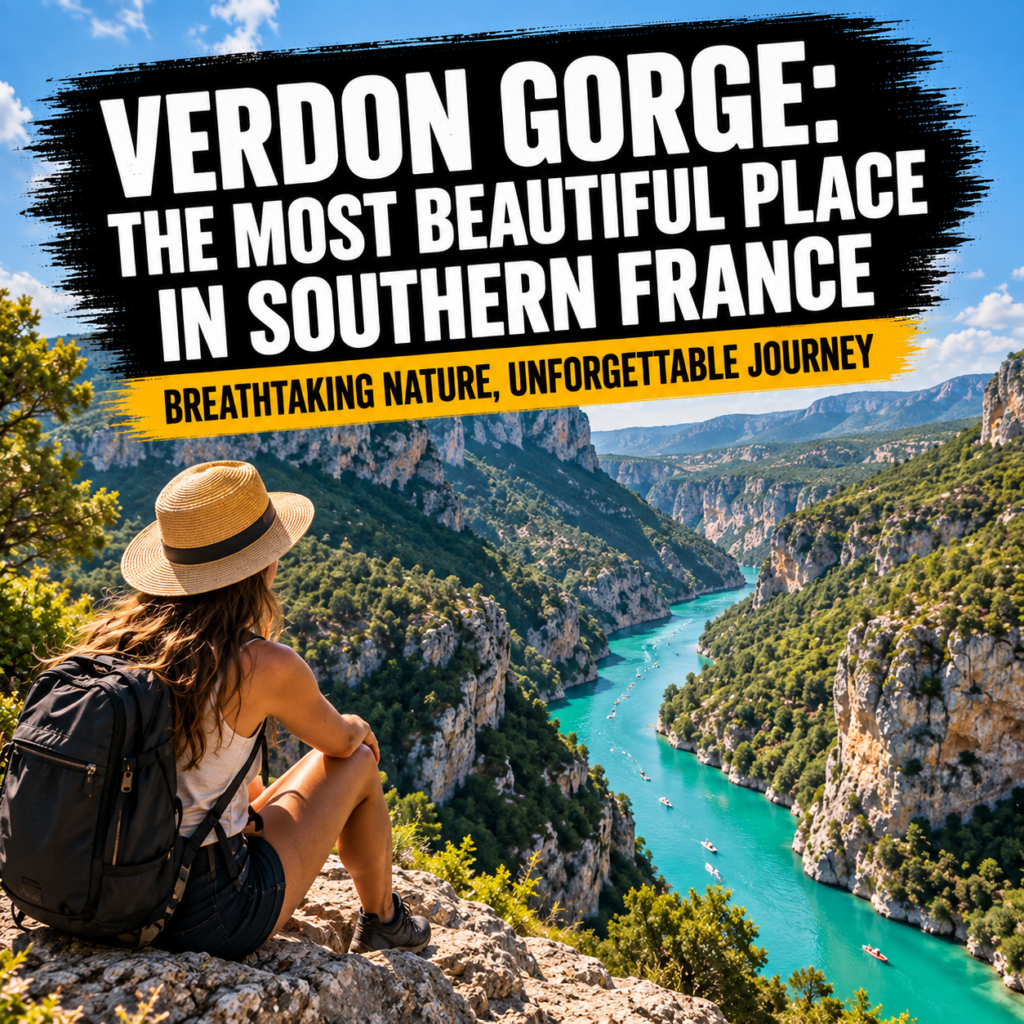
Verdon Gorge: The Most Beautiful Place to Discover in Southern France for an Unforgettable Journey
The Verdon Gorge is one of those places in Europe where the landscape feels almost unreal. Turquoise water, dramatic limestone cliffs, pine-covered hills and winding mountain roads come together to create a destination that looks more like a painting than a real corner of France. Located in Provence, in the southeastern part of the country, the gorge offers a remarkable combination of wild nature, peaceful villages and outdoor adventures. It is especially appealing to travelers who want to experience southern France beyond the familiar streets of Nice, Cannes or Marseille. Here, the scenery becomes the main attraction, and even a simple drive through the surrounding countryside can turn into one of the most memorable parts of a trip.The Verdon Gorge is also remarkably versatile. You can spend several days exploring viewpoints and mountain roads, hiking along the cliffs, kayaking across the calm turquoise waters or simply enjoying the atmosphere of Provence from a small village nearby. The best experience comes when there is no need to rush from one attraction to another. The gorge rewards travelers who slow down, follow the curves of the landscape and allow enough time to appreciate the changing colors of the water, rocks and forests. For anyone planning a trip through southern France, Verdon is a destination that deserves much more than a brief stop.
The Best European Countries for a Comfortable Family Trip with Children
Traveling around Europe with children can become not only a comfortable family vacation but also a real adventure that stays in everyone’s memory for years. The continent offers an enormous variety of destinations where families can combine sightseeing, nature, beaches, entertainment, educational experiences and cultural discoveries without constantly adjusting their plans around complicated logistics. For families, convenient roads, reliable public transportation, varied food options, safe urban environments and the ability to alternate busy days with relaxed breaks are especially important. That is why choosing a country should depend not only on the number of famous attractions but also on how easily the trip can be organized so that both adults and children enjoy it.A family vacation in Europe can take many different forms. Some families prefer seaside resorts and long beaches, while others are more interested in castles, theme parks, museums and beautiful historic cities. There are destinations that are particularly convenient for traveling with young children, while other countries are better suited to school-age children and teenagers because of their active entertainment and varied sightseeing opportunities. Among the many possibilities, Spain, Italy, France, Austria and Portugal stand out particularly well. Each offers its own balance between relaxation, experiences and the opportunity to spend quality time together without constantly rushing from one place to another.
10 Natural Wonders in Europe That Nature Lovers Should Add to Their Travel Plans
Europe can surprise travelers with far more than historic cities, museums and architectural landmarks. Across the continent are vast mountain ranges, volcanic valleys, glacial lakes, northern islands, wild coastlines and forests where nature still defines the character of entire regions. For travelers who would rather see a waterfall, climb to a viewpoint or spend several hours hiking a mountain trail than remain in a city center, Europe offers an enormous range of possibilities. Many of these destinations can also be combined into longer journeys, allowing travelers to experience completely different climates, landscapes and even patterns of daylight within the same trip.Choosing a destination for a nature-focused journey is best done not only according to popularity, but also according to the type of experience you want. Some travelers are drawn to the glaciers and volcanoes of Iceland, while others prefer Alpine lakes and high mountain valleys. Some want dramatic northern coastlines and remote islands, while others are looking for forests, waterfalls and peaceful hiking trails. There are places where nature impresses through sheer scale, while others are memorable because of their silence and sense of isolation. The following ten European destinations are particularly well suited to travelers who want to spend their trip surrounded by natural landscapes and discover the continent from a completely different perspective.
The Most Scenic Train Routes in Europe That Turn the Journey Into a Destination
A train journey across Europe can be much more than a simple way to get from one city to another. There are routes where trains pass through mountain passes, along lakes, past waterfalls, historic villages and dramatic coastlines, while the landscape changes almost every minute. On such journeys, there is no need to constantly check the route or think about the road ahead. You can simply settle into a seat by the window and watch the scenery change. Some of the most spectacular railways were built through challenging natural terrain, where tunnels, bridges and viaducts have become part of the experience themselves, offering views of the landscape from an unusual perspective.Europe is particularly well suited to this kind of travel thanks to its extensive railway network and the many regions where train tracks run directly through remarkable natural landscapes. You can head into the Alps, cross the Norwegian highlands, travel through the valleys of Scotland or follow the Mediterranean coast of Italy. These journeys work equally well as part of a short break or a longer trip across several countries. Their greatest advantage is that the experience begins long before you reach your destination, and sometimes the journey itself becomes the most memorable part of the entire trip.One of Europe’s most impressive railway experiences is the Bernina route, connecting the Swiss region of Graubünden with the Italian town of Tirano.
Lofoten Islands: Northern Nature, Fishing Villages and a Journey Without the Rush
The Lofoten Islands lie in northern Norway, far above the Arctic Circle, and look as if nature deliberately gathered some of the most dramatic northern landscapes in one place. Sharp mountain peaks rise directly from the sea, small fishing villages are tucked between rocky slopes, and roads run along bays, beaches and green valleys. There is no feeling of a huge tourist resort filled with endless entertainment. Instead, the strongest impressions come from space, silence and the constant change of scenery outside the window. Lofoten is ideal for travellers who want more than simply visiting a famous destination and would rather slow down for a few days and immerse themselves in nature.Another special feature of Lofoten is that you do not need a complicated itinerary to have an unforgettable experience. You can drive between the islands, stop at small bays, walk along trails, explore villages and spend evenings beside the water. Even a short trip reveals completely different sides of the archipelago: dramatic mountains, white sandy beaches, traditional fishing cabins, clear water and small settlements where life is still closely connected with the sea. Lofoten is at its best when travellers do not try to see absolutely everything, but instead leave enough time for places and moments that cannot be planned in advance.For a first introduction to the archipelago, it is best to allow several days and build the route around the main road connecting many of the islands.
Copenhagen for a Weekend: How to See the Best of Denmark’s Capital and Find Its Perfect Rhythm
Copenhagen is an ideal destination for a short trip when you want a change of scenery, plenty of walking, good food and the chance to experience a different European atmosphere without trying to cross an entire country in a few days. The Danish capital is compact and easy to explore on foot, combining completely different impressions: historic royal palaces stand alongside modern architecture, quiet canals run through lively neighbourhoods, and green parks can be reached within minutes from the busiest central streets. You do not need to create an exhausting schedule from morning until night, because much of Copenhagen’s appeal comes from simply wandering through the city.For a perfect weekend in Copenhagen, it is worth leaving room not only for the famous attractions but also for ordinary city life. You can begin the morning with coffee and fresh pastries, walk along the waterfront, visit a food market, explore the historic districts, spend the evening in an amusement park or a small restaurant, and simply enjoy the streets in between. Two or three days are enough to see the main sights without turning the entire trip into an endless race between attractions. The best approach is to combine a few planned stops with enough free time to discover the city at your own pace.The first introduction to Copenhagen is best made through the historic centre.
Iceland in One Week: Waterfalls, Volcanoes and Glaciers Along an Unforgettable Route
Iceland can feel like a country that is impossible to experience in a single trip because its landscapes are so diverse. On a relatively small territory, enormous glaciers exist alongside active volcanic areas, black-sand beaches, geothermal fields, deep canyons and waterfalls that look almost unreal. For a first trip lasting seven days, there is no need to attempt a complete tour of the island along the Ring Road. A much more practical approach is to concentrate on southern Iceland and combine several of the country’s most impressive natural attractions. This route makes it possible to see waterfalls, volcanic landscapes, glaciers and coastal scenery without spending most of the holiday behind the wheel.The biggest advantage of travelling through southern Iceland is the dramatic change in scenery within relatively short distances. A morning can begin among geothermal landscapes, followed by an afternoon beside a powerful waterfall and an evening surrounded by icebergs floating in a glacial lagoon. A route connecting Reykjavik, the Golden Circle and the South Coast can gradually lead towards Jökulsárlón, creating a journey that feels much longer than seven days because the landscape changes so dramatically. This format also leaves enough time for short walks, viewpoints and spontaneous stops, which are often just as memorable as the famous attractions themselves.The first day can be devoted to Reykjavik and an introduction to the atmosphere of Iceland.
Sicily for First-Time Visitors: Where to Go, What to See and When to Travel
Sicily is one of those European destinations that cannot be fully understood through a single photograph or a short list of attractions. The largest island in the Mediterranean combines ancient cities, volcanic landscapes, Baroque architecture, long beaches, mountain villages and lively port streets. Completely different worlds exist side by side here: ancient temples and modern cafés, elegant resorts and small fishing communities, busy markets and quiet roads surrounded by olive groves. That variety is exactly what makes a first trip to Sicily so appealing, but it also means that some planning is useful. Trying to see the entire island in only a few days can easily turn a holiday into a constant sequence of long drives. It is much more rewarding to choose several areas and experience them without rushing.For a first introduction to Sicily, a route connecting Palermo, Cefalù, Taormina and Mount Etna works particularly well, with Syracuse or Noto added if there is enough time. This combination reveals several completely different sides of the island without forcing travellers to concentrate exclusively on beaches or historical monuments. Palermo introduces visitors to Sicily’s complex history and distinctive cuisine, Cefalù offers a relaxed Mediterranean atmosphere, Taormina combines spectacular views with ancient heritage, while Mount Etna demonstrates that Sicily is not simply a destination of beaches and old towns but also a land shaped by an active volcano.
What to See in Salzburg: Main Attractions, Hidden Gems and the City’s Unique Atmosphere
Salzburg is one of those European cities where even an ordinary walk through the historic centre can easily turn into a journey through time. Narrow streets, Baroque façades, church domes, historic squares and a fortress rising above the city create a remarkably coherent architectural image. At the same time, Salzburg is not simply an open-air museum. Cafés and shops are open, concerts take place throughout the city, local residents move through the streets, and beyond the historic centre there are green neighbourhoods and mountain landscapes. It is precisely this combination of history, music and nature that makes the city particularly appealing for travellers.The main attractions of Salzburg are located relatively close to one another, making the historic centre easy to explore on foot. In one day, it is possible to see Hohensalzburg Fortress, walk along Getreidegasse, visit Residenzplatz, enter Salzburg Cathedral, explore Mirabell Gardens and discover places connected with Wolfgang Amadeus Mozart. If you have more time, it is worth visiting Hellbrunn Palace or climbing one of the viewpoints overlooking the city and the surrounding Alps. Salzburg is especially suitable for travellers who enjoy combining architecture, history, music and relaxed walks.The best place to begin exploring Salzburg is Hohensalzburg Fortress, which rises above the Old Town on the summit of the Festungsberg.